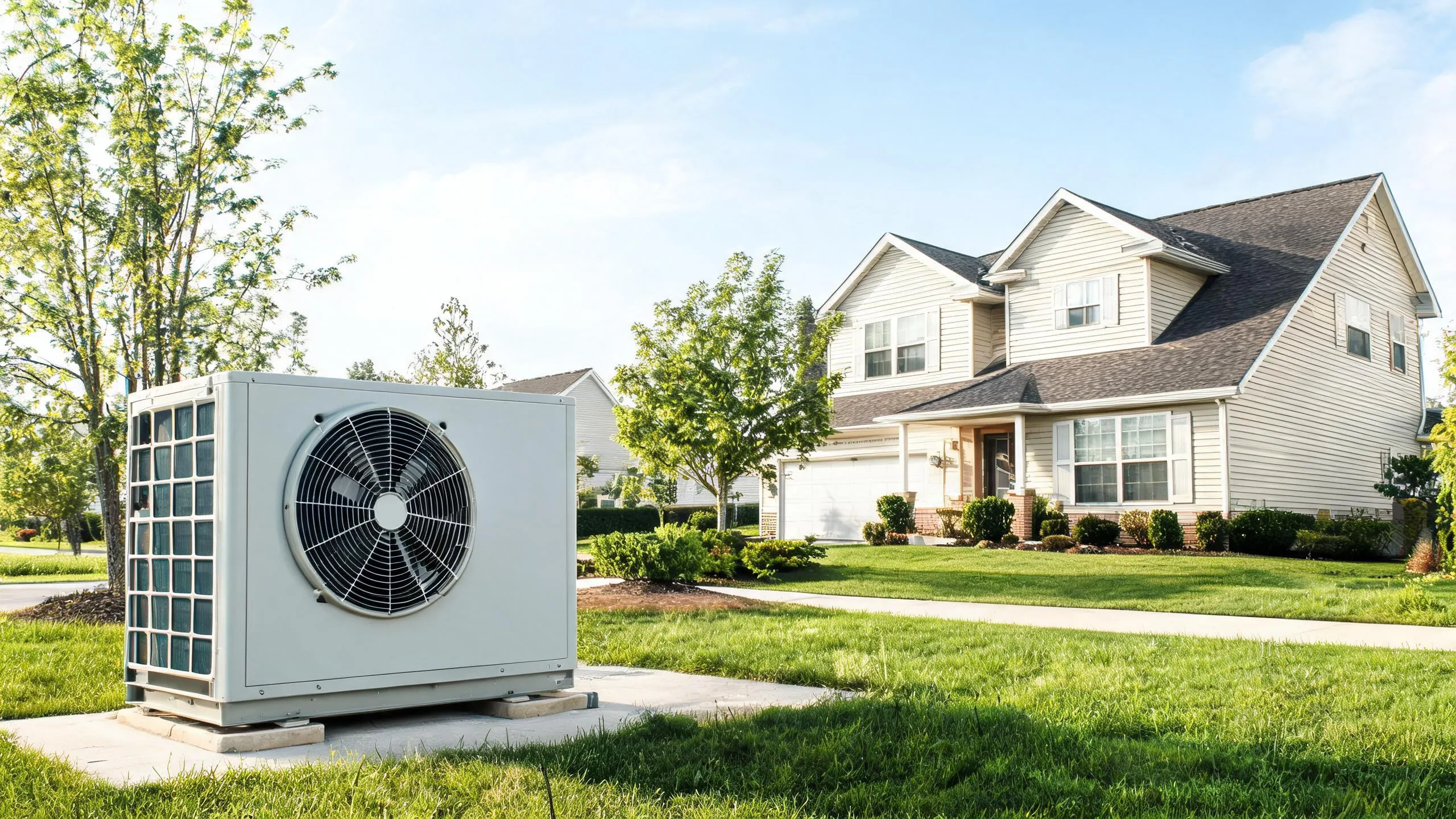






An outdoor heat pump unit mounted on a concrete pad in front of a two-story suburban house with a landscaped lawn.

Heat Pump Repair in Hugo, OK

Tell us about the job

Takes about a minute. No obligation.

RepairHeat PumpChoctaw County, OK
Step 1 of 2

What ZIP code is the job in?

A heat pump in Choctaw County earns its keep. Summer air here sits heavy, with the dew point averaging 68 degrees across June, July and August, which is thick even by Oklahoma standards. To pull comfort out of air that wet, the system has to run longer and work harder than one in a drier county. That strain lands on the same parts every time: the compressor, the contactor, the capacitor that gets it started. Add a winter where that same unit has to reverse itself and pull heat out of cold air, and there's barely a season when it gets to coast. A problem that looks small, a system that's slow to recover or short cycling, usually traces back to a part that's been working harder than it was built for. Getting it looked at properly now is what keeps a small repair from turning into a bigger one.

5 months
November through March, your system heats
5 months
May through September, it cools
33°F
the average winter night it heats against
92°F
the average summer afternoon it cools against
Isometric cutaway illustration of a single-story house showing interior rooms with furniture, an attic duct network connected to a furnace or air handler, and an outdoor condenser unit linked by lines outside the wall.
Your system heats November through March and cools May through September.

NOAA nClimDiv, 1991–2020 normals

A dirty outdoor coil makes the compressor work to push heat where it shouldn't have to.

Rinsing it off with a hose is something you can check before paying someone to tell you the same thing.

With a newer system, a stuck valve or a weak capacitor is worth fixing

Half the homes here were built by 1982
Power here costs 13.94 cents per kilowatt-hour
Climate zone 3A
The First Cold Snap Finds the Weak PartHeat starts running in November here, and that's when a part that was already failing finally gives out.

A diagnostic visit starts outside, with gauges on the lines and an amp reading on the compressor while it's running, not just a look at it sitting still. A tech checks the capacitor's output against what it's rated for, because a weak one can still kick the compressor on and still be the thing that's about to leave you without a system. The reversing valve gets tested both directions, since a valve that shifts fine once can still be the one that sticks on the next call. Airflow across both coils gets checked too, indoor and outdoor, because a coil that's choked with dirt or blocked by a dirty filter can mimic a refrigerant problem that isn't really there. None of this is guesswork. It's a process of ruling things out until what's left is the part that's actually failing, so the repair fixes that and not something that was never the problem.

The strain is the diagnosis

The part that failed didn't fail at random. It's been running longer hours than the same part would in a milder climate, and that catches up with something eventually. Have it diagnosed before you decide whether it's a quick fix or something more.

Find a contractor
A dark gray heat pump unit mounted on a concrete pad next to a house with gray siding and a stone veneer wall.

What Actually Gives Out

A heat pump has two running states that wear it in different ways, and both get exercised every year. The reversing valve is what switches it between them. That valve has to shift fully each time, and if it starts sticking, you'll notice the system blowing air that's not quite as warm or as cool as it should be before you notice anything else. The compressor takes the steadier beating. It's running on both sides of the switch, summer and winter, and every start puts a load on the capacitor and contactor that get it moving. A capacitor weakens slowly, then fails all at once, usually as a unit that hums but won't start or that starts and shuts back off. The contactor's points pit and burn over time from the arcing, until one day they don't make contact. None of this happens because a unit is old. It happens because it's been asked to start and stop and reverse itself over and over without a break long enough to matter.

What you'll actually notice

The signs rarely show up as the part that's really failing. Warm air blowing in summer or cool air blowing in winter usually means the reversing valve isn't shifting all the way. A unit that hums without starting, or kicks on and shuts right back off, points to the capacitor or contactor. Ice building up on the outdoor unit when it shouldn't, or the system running long stretches without ever feeling like it caught up, both mean it's working harder than it should to do the same job.

Why it's worth a look now

A heat pump rarely goes from fine to broken in one step. Short cycling strains the same capacitor and contactor that are already wearing down, and a reversing valve that sticks occasionally today sticks for good eventually. Waiting usually doesn't mean nothing happens, it means the part that's struggling finishes failing on a day when you need the system most.

A heat pump that's struggling doesn't fix itself by staying on. If the reversing valve is sticking partway, every cycle it runs forces refrigerant through a path that's partly blocked, and that back pressure is what damages the valve further. A compressor that's starting hard on a weak capacitor is drawing more current than it should every single time it kicks on, and that heat builds up in the windings a little more with each start. Ice on the outdoor coil blocks airflow, so the system runs longer to move the same amount of heat, which pulls in more moisture, which makes more ice. Shutting it down and getting the part looked at stops that cycle. Leaving it running usually just moves the failure from an inconvenience to a breakdown.

Repair makes sense when the part that failed is one piece doing one job. A capacitor, a contactor, a reversing valve, even a blower motor are all things a tech can replace without touching the rest of the system, and the compressor that's been running fine keeps running fine. Replacement starts to make more sense when the compressor itself is the problem. It's the one part that's expensive to swap on its own, and a failing compressor is often a sign the whole system has been under strain for a while, not just that one part wore out. Age matters less than what's actually broken. A unit that's given years of trouble-free service and throws one bad capacitor is not the same situation as one where the compressor is struggling and the reversing valve is starting to stick around the same time. When problems start stacking up close together, that's usually the system telling you it's done compensating.