
Why your heat pump smells like burning in Oklahoma
Why does my heat pump smell like it's burning?
A burning smell from a heat pump gets your attention fast, especially when it's running the house all day keeping everyone comfortable. You want to know if this is something to shut off right now or something that will clear on its own. The smell usually points to one of a few causes, and which one it is changes what happens next and whether the system is safe to leave running.
A dust burn-off smell clears in minutes; anything electrical or sharp doesn't
If your heat pump just switched over after sitting idle, a mild burning or dusty smell for a few minutes is dust burning off the coil or heat strips and it should fade on its own. A smell that lingers, or smells sharp like burning plastic or wiring, is different. That points to a motor running hot, a wiring connection failing, or a component overheating inside the unit. With power cheap here, a lot of Oklahoma homes lean on the heat pump instead of gas even on cold mornings, so it runs more hours than it might elsewhere, and that extra run time means worn parts show up sooner. If the smell is sharp or doesn't go away, shut the system off at the thermostat or breaker and have it looked at before running it again.

Summer air here sits at a dew point around 66°F, averaged across June, July and August, according to NOAA climate data. That's heavy, damp air for your heat pump to pull moisture out of all day long. The harder it works at that, the warmer its parts run, and dust or pet hair sitting on a coil or motor can start to scorch under that extra heat. That's often where a burning smell comes from in summer, not a sign the unit is failing outright, but a sign it's working against thick air with something on it that shouldn't be there.
NASA POWER T2MDEW county cells weighted by homes

What that smell means for your house
A burning smell usually means something electrical is hot, a stuck contactor, a motor bearing, a wire rubbing somewhere it shouldn't. With your heat pump pulling moisture out of thick summer air for hours at a stretch, parts already running warm have less room to run hotter before something gives. Left alone, that can mean a tripped breaker in the middle of a hot afternoon, or a part that fails outright instead of needing a simple fix.
You don't have to figure out which part it is before you call someone. You also don't have to spend the afternoon getting three companies on the phone, telling each one the same thing, then sitting with three quotes trying to guess who's right. One call connects you with a licensed Oklahoma contractor who works on heat pumps all summer and knows what tends to fail first in this heat. You explain it once, to the person who's actually coming out.


Running it through summer heat
Your heat pump is likely the only thing cooling the house, cycling on for hours at a stretch through the hottest part of the day. A burning smell that shows up during a long run is often tied to a part that's been under load the whole time it's been on, a contactor making poor contact or a motor that's been turning without enough air moving across it to carry the heat away.

A short run in winter
With gas heat common here, your heat pump may only kick on for short bursts, maybe during a cold snap or as backup when the gas furnace can't keep up alone. A burning smell on one of those short runs points somewhere different, often dust burning off a heat strip that hasn't run in months, or a connection that was already loose before it ever got asked to carry current.
Shut It Off or Let It Run
Shut it off
- You lose cooling right when the house needs it most, and in an Oklahoma summer that can mean hours without relief before a contractor gets there.
- A stuck contactor or hot wire stops getting worse the moment the system stops running, which matters if nobody caught it early.
- Whatever is overheating doesn't get the chance to spread to a part it hasn't touched yet, like a blower motor or circuit board nearby.
- You lose the chance to describe the smell and sound to a technician while the unit is actually doing it, which can slow down the diagnosis.
- If the smell was faint and intermittent, shutting down means you can't tell the contractor whether it was constant or came and went.
Keep it running
- A local contractor who services heat pumps all summer can often tell from the smell alone whether it's a contactor, a motor bearing, or a wire rubbing somewhere it shouldn't.
- Leaving it on gives that contractor a live system to test instead of a dead one, which can mean finding the actual fault instead of guessing at it.
- If the smell is tied to a part under strain from hours of pulling moisture out of thick air, running it longer risks that part failing outright.
- A burning smell that holds steady while the system runs is more useful information for a technician than one that stopped twenty minutes ago.
- You risk a small failure turning into a bigger one, like a contactor that welds shut or a motor that seizes mid-cycle.
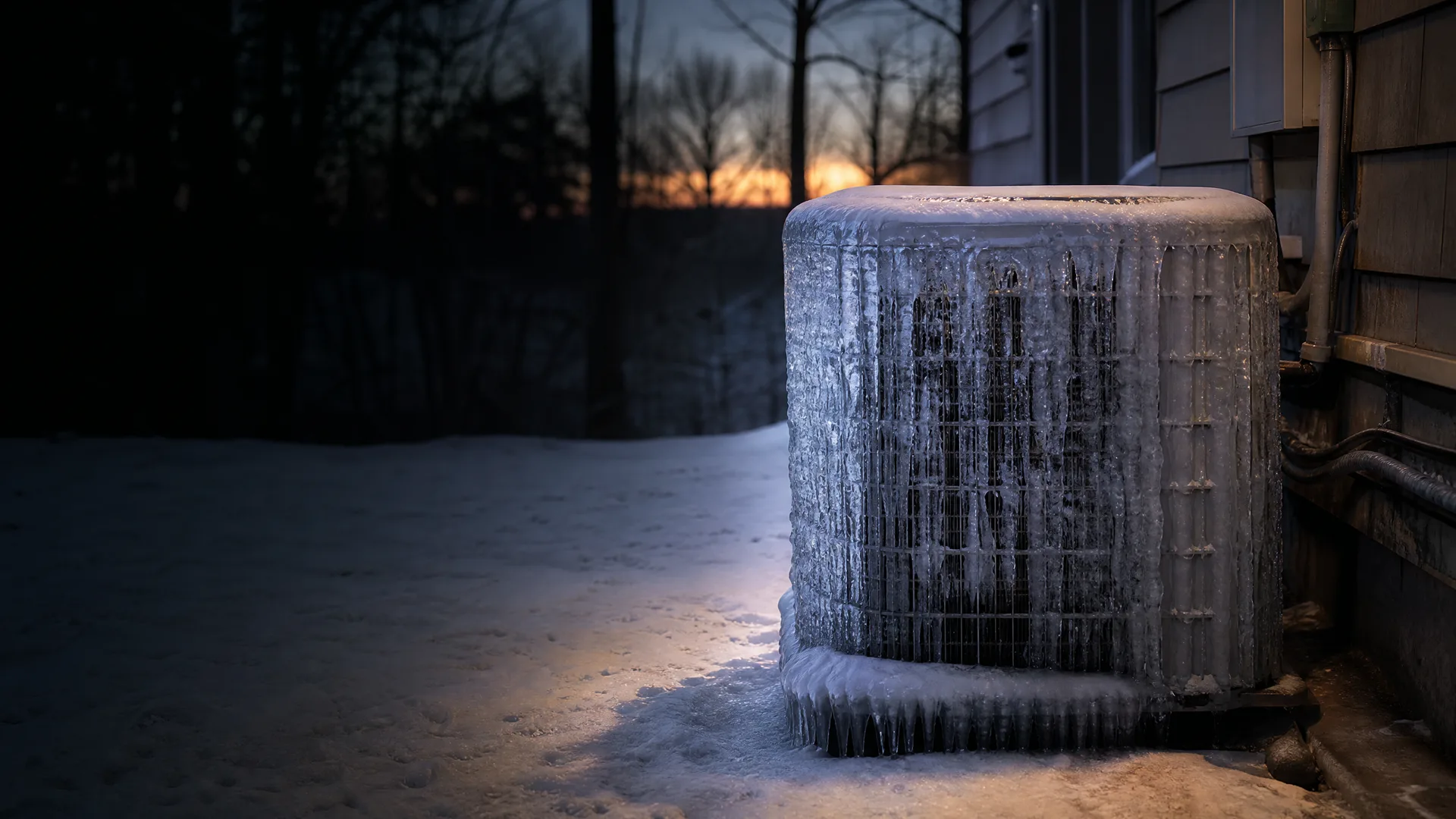
January dawn, maybe six thirty, still dark at the edges of the yard. Frost is thick on the grass and the air has that flat, still cold Oklahoma gets a few mornings a winter. You walk out in your coat to check on the outdoor unit and find it wrapped in ice, a solid half inch over the coils, nothing moving. No fan noise, no hum, just quiet. You crouch down and knock on the casing and ice flakes off in a sheet. Somewhere inside the house the air handler is still running, blowing air that isn't warm anymore. You stand there a minute, breath fogging, trying to decide if this is something that clears on its own by noon or something you need someone out for today.
Explain it one time

Only one pro gets your request, so you hear from one company.
No charge to send it. You decide if you hire them.
What's actually burning
- A burning smell with no smoke is often the outdoor unit's start capacitor or contactor overheating under long summer runs.
- A burnt dust smell usually clears within an hour of the system kicking on after sitting idle, and isn't the same as an ongoing burning odor.
- An acrid, plasticky smell points to wiring insulation breaking down inside the air handler or at the disconnect box.
- A hot, metallic smell can mean the blower motor or outdoor fan motor bearings are wearing out and running hotter than they should.
- The reversing valve, which switches your heat pump between cooling and heat, can stick and strain the compressor enough to produce a burning odor.
- Heat pumps run compressors and motors nearly nonstop through Oklahoma summers, which shortens the time between a part wearing out and it showing up as heat or smell.
Every part named above fails for a reason tied to how your heat pump runs. The start capacitor gives the compressor and outdoor fan a jolt of power to get moving, and the contactor is the switch that sends power to the outdoor unit each time it cycles on. Run that cycle for hours at a stretch, day after day, and the contacts pit and the capacitor weakens, and either one can run hot enough to smell it. A burnt dust smell is different. Dust settles on the heat exchanger or coil when the system sits off, and it burns away clean the first few minutes it runs. If that smell doesn't fade, something else is going on. Wiring insulation breaking down smells sharper, more like melting plastic, and it shows up at connections that have worked loose or rubbed against metal inside the air handler or disconnect box. Bearings in a blower or outdoor fan motor announce themselves with heat and a metallic smell before they announce themselves with noise. The reversing valve gets less attention because it only shifts the system between modes, but if it sticks halfway, the compressor has to work against itself, and that strain shows up as heat. None of these parts are built to idle. In Oklahoma, they barely get the chance.




How a heat pump moves heat
Your heat pump doesn't make cold air in summer. It picks up heat from inside the house and moves it outside, using the same refrigerant loop and the same outdoor unit it uses for heat in winter, just running in reverse. That reversing valve, the compressor, and the fan motor are doing this swap for hours at a stretch on a hot Oklahoma afternoon. Every part in that loop is carrying a load the whole time the system runs, not just at startup. A smell tied to overheating tends to show up on these long runs because that's when a weak part finally gets stressed enough to heat up past where it should.
What a contactor actually does
The contactor is a small switch that sends power to the outdoor unit's compressor and fan every time the system calls for cooling. It closes and opens that connection dozens of times a day through a long Oklahoma summer. Each time it closes, there's a small arc of electricity across its contacts, and over thousands of cycles those contacts wear down and pit. A worn contactor can start sticking or arcing more, which runs hotter than a clean connection should. That's the kind of part failure behind a burning smell that shows up after the system has been running the house for hours.


Keep running it to see if the smell fades
If it's a part working too hard, more run time just pushes it closer to failing outright, and most people don't catch a bad smell until it's already been going a while.
Power costs 13.21 cents per kilowatt-hour statewide
At 13.21 cents a kilowatt-hour, running your heat pump through a long summer cycle doesn't hit the budget the way it would in a lot of other states. That's worth knowing before you decide to just keep running it on a burning smell. The cheap part is the electricity. A stuck contactor or a failing motor still gets worse the longer it runs, no matter what the bill says.
EIA-861 2025 statewide residential average
A burning smell from your heat pump means a part is working harder than it should, and the fix is finding which one before it fails outright. A contractor who services heat pumps in your area all summer long has seen this exact complaint plenty of times, a contactor pitted from cycling on and off for hours, a capacitor that's weak and running hot. That's the kind of thing that gets spotted fast by someone who already knows where to look on this equipment, not guessed at. You'll get matched with one licensed local contractor for this, not a handful of companies calling you back at once, so you explain what you're smelling one time to the person who's actually coming out. The smell is your heat pump telling you something is close to the edge. Getting the right person looking at it is what settles whether that's a quick fix or something more.





Skip the calls to every shop
Your request stays with one local pro.
There's no charge for the request.