




A tall wooden privacy fence runs along the left side of a dry grass lawn, with a row of single-story brick houses with dark shingled roofs on the right and oak branches overhead against an overcast sky.

Furnace Maintenance in Pauls Valley, OK

Tell us about the job

Takes about a minute. No obligation.

Tune-up, service, or cleaningFurnace or heatingGarvin County, OK
Step 1 of 2

What ZIP code is the job in?

Garvin County saw 147 severe weather events between 2015 and 2024. That includes 55 damaging wind events, 73 hail events, and 12 tornadoes. Hail dents and cracks the fins on an outdoor unit, and wind storms throw branches and debris into it. A furnace tune-up should include a look at that outdoor unit, not just the parts inside the house. Statewide, a quarter of Oklahoma households went at least a full day without power in 2024, and a furnace that is already struggling has less room to handle a hard restart once the power comes back.

Furnaces here start working for real in November.

Get the tune-up done in October, before that first cold morning puts the system to the test.

Most homes here run on electric heat, and that changes what a tune-up needs to catch

65.3% of homes heat with electricity
Heat runs November through April
Winter nights average 31°F
Half the Furnaces Here Are Older Than the Code They Were Built UnderHalf the homes in Garvin County went up in 1973 or earlier, and the furnace inside one often has that same history.

Six months of heat a year is a light load. Your furnace in Garvin County runs November through April, then sits the other half of the year. That kind of schedule doesn't wear a system down the way a year-round furnace wears down elsewhere. When something does go wrong here, age or neglect is usually the reason, not overwork. Light duty still means a yearly check matters. A furnace that only runs half the year can sit through the off months with a small problem nobody noticed, and that problem is waiting for the first cold morning in November.

Get the Outdoor Unit Checked Before the Next Storm, Not After

A tune-up is the chance to get that outdoor unit looked at before the next storm rolls through, not after. Have it checked for bent fins, loose panels, and anything wind or hail already left behind.

Find a contractor
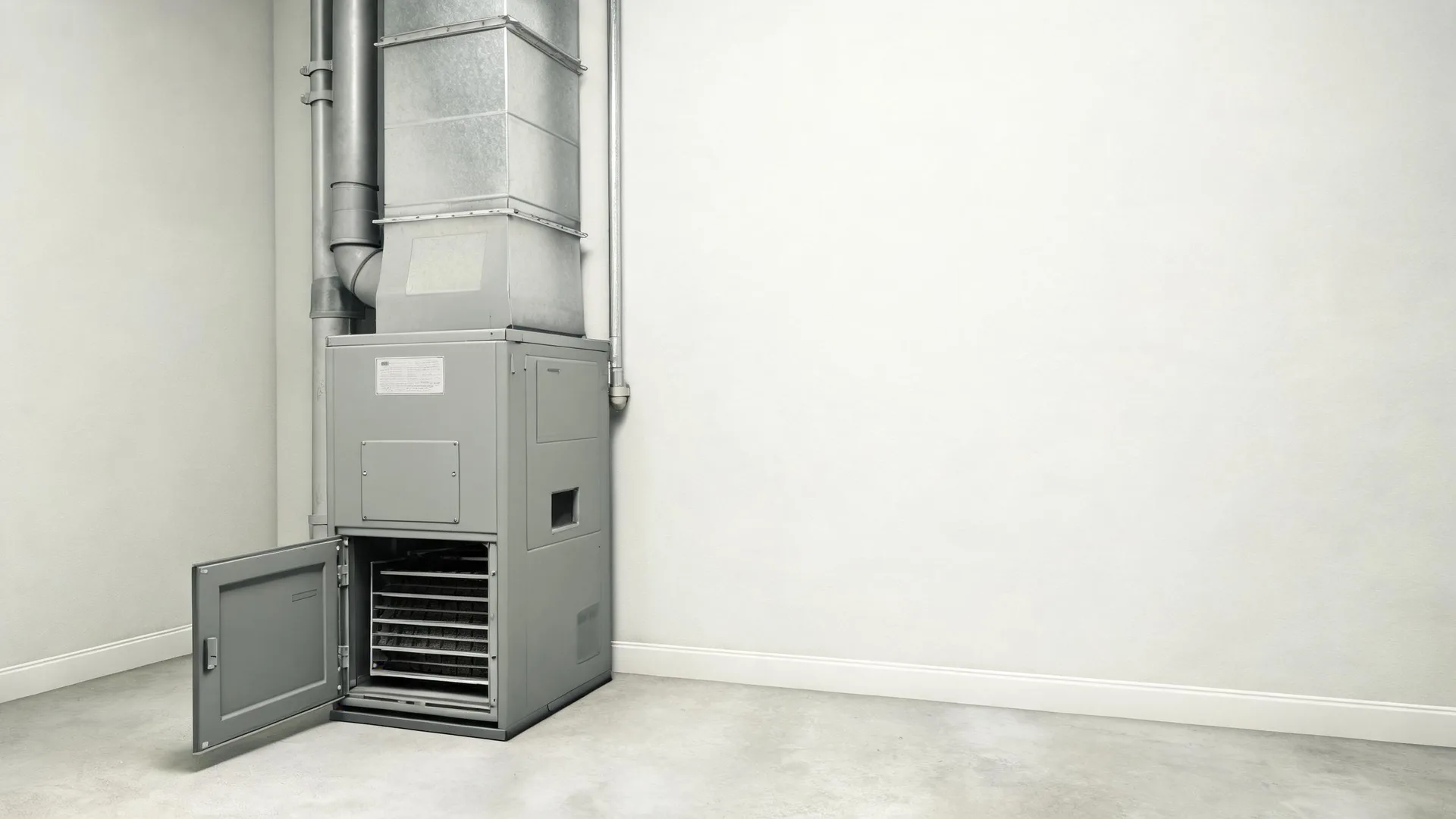
A gray high-efficiency gas furnace installed in an unfinished basement, surrounded by gas lines, a condensate drain, and sheet-metal ductwork.

An Old Furnace Doesn't Announce Itself

If your furnace has been there since the house was built, a yearly check is what catches a cracked heat exchanger or a worn igniter before it fails on a cold morning. The tune-up is the one time a year someone has eyes on the burner assembly and the flue, not just the filter. Ask what year your unit was installed. If nobody knows, that's its own answer, and it's reason enough to get it looked at now.

Change the Filter

A dirty filter chokes airflow across the heat exchanger and makes the burners work harder to push warm air through the house. Check it every month the furnace is running, and hold it up to the light. If you can't see through it, swap it. A clean filter also keeps dust off the blower wheel, where buildup throws it out of balance over time.
Know What to Leave Alone

The burner assembly, the igniter, the flue and the heat exchanger are not homeowner territory. Opening the cabinet to poke at them risks a gas connection or a cracked exchanger leaking carbon monoxide into the house. Keep the area around the furnace clear of boxes and stored items, keep vents and return grilles unblocked, and leave what's behind the panel for the yearly check.

A quick tune-up checks that the furnace lights and blows warm air, then calls it done. A thorough one goes further. The igniter should get tested under load, not just looked at, since a glow plug or hot surface igniter can glow weakly and still fail to light the burners reliably. The flame sensor should be cleaned and checked for a steady signal, not just rod length. The heat exchanger needs an actual inspection for cracks or corrosion, because a cracked exchanger can leak carbon monoxide into the air the blower pushes through the house. Gas pressure should get checked and adjusted at the manifold, not assumed correct from the factory setting. The blower wheel and motor should come out for a real cleaning if there's buildup, not a quick wipe with the cabinet still shut. If the technician is in and out in a few minutes, or never pulls a panel, that's not the same inspection as one where someone tests the safety controls, checks amp draw on the motor, and confirms the flue is drafting properly.

A yearly check on a furnace this lightly used is mostly about catching what age or neglect left behind, not fixing wear from hard running. That makes the tune-up worth doing even when the machine looks fine. A technician who tests the igniter under load or checks gas pressure at the manifold can find a problem months before that first cold morning in November, while there's still time to fix it on a normal schedule instead of in the middle of a cold snap. Here, that matters more than most places, since a long power outage can force a hard restart on a system nobody has looked at all year. Light duty buys this furnace time. The check is what you do with that time.