A row of single-story brick houses with dark shingled roofs along a dry grass yard, bordered on the left by a tall wooden fence, with tree branches overhead under an overcast sky.

Furnace Repair in Woodward, OK

Tell us about the job

Takes about a minute. No obligation.

RepairFurnace or heatingWoodward County, OK
Step 1 of 2

What ZIP code is the job in?

Storms come through often here

Woodward County saw 225 severe weather events between 2015 and 2024, with damaging wind alone hitting 144 times and hail 61 times. Four tornadoes touched down in that same stretch. A furnace shares the house with whatever a storm does to the roof, the vents and the power lines feeding it.

Power doesn't always come back fast

A quarter of Oklahoma households went at least 24 hours without power in 2024. A gas furnace still needs electricity to run the blower and the control board, so a long outage means no heat even with the gas line intact.

7 months
October through April, your furnace is on duty
25°F
the average winter night it heats against
15 winter storms
in ten years, the nights a failure hurts most
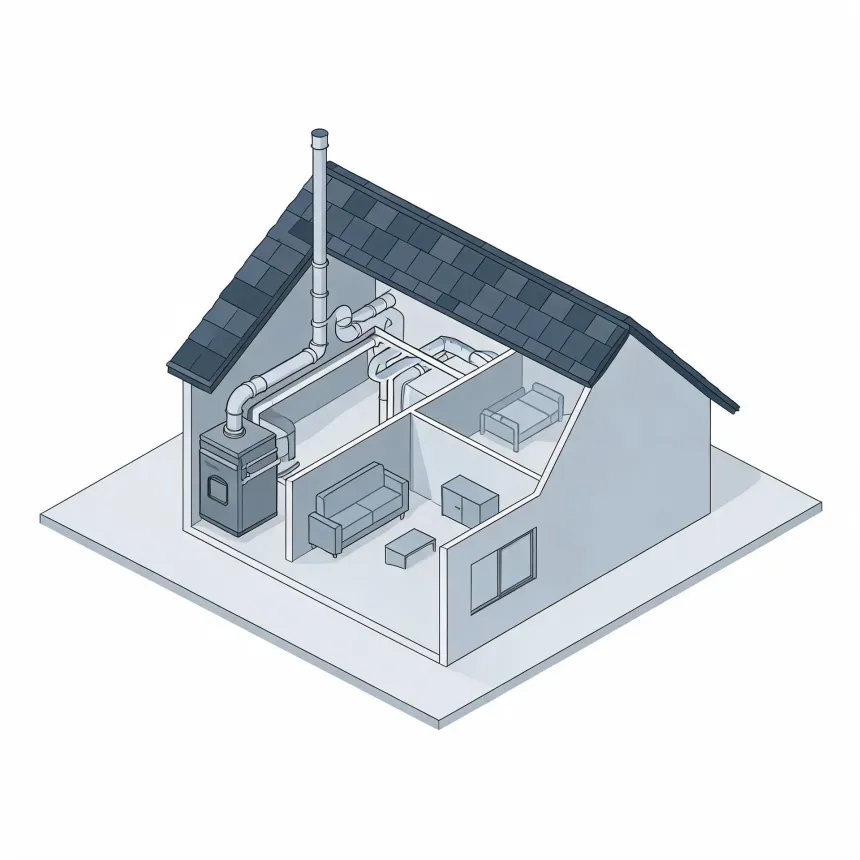
Isometric cutaway illustration of a small gabled house showing a furnace with flue pipe and ductwork connecting to interior rooms containing a sofa, bed, and cabinets.
Your furnace works hardest from November through March.

NOAA nClimDiv, 1991–2020 normals

A furnace won't start or run right for a short list of reasons.

A tech checks the igniter, the flame sensor, the control board and the pressure switch before touching anything else.

Seven months of heat starting in October, so a weak part fails right when you need it

Heat runs October through April
Winter nights average 25°F
15 winter storms from 2015 to 2024

A furnace rarely dies all at once. It gives you signals first: short cycling, a longer delay before the burners catch, a blower that runs louder than it used to. The question with an older unit is whether you are fixing one part or paying to patch a system that is failing on several fronts at the same time. A cracked heat exchanger ends the conversation, since that is a safety issue and not a repair. Worn igniters, failed pressure switches and bad control boards are a different matter. Those are normal wear parts, and swapping one out on a furnace that is otherwise sound is usually the right call. The harder case is a furnace already past the age where parts are getting harder to source. At that point each repair buys you some time, but not much certainty about what fails next.

If a storm has come through, get the furnace checked along with the roof

If hail or wind has come through recently, have the furnace looked at even if it still runs. The outdoor parts of the system take the same hit the roof does, and a furnace that starts fine today can be running on a damaged part. Worth finding out now instead of on the first cold night after.

Find a contractor
A gas furnace with attached ductwork, gas piping, and condensate lines installed in a concrete-block basement.

It warns you before it quits

A furnace usually tells you something is wrong before it quits for good. The burners might take longer to catch, or light with a louder pop than usual. The blower might run on after the house has reached temperature, or kick on and off in short bursts instead of settling into a steady cycle. Some of this shows up as a smell, a little like dust burning off, that should fade in a minute and doesn't. Some of it shows up as sound: a rattle from the cabinet, a screech from the blower motor, a clicking that repeats when the igniter is trying and failing to light the burners. A pilot or igniter that won't hold, a burner flame that looks yellow and ragged instead of steady blue, a thermostat that calls for heat and gets nothing back. Any of these is the furnace asking for a look before it stops working altogether. The one sign that changes the conversation entirely is soot around the cabinet, or a carbon monoxide alarm going off. That points to a cracked heat exchanger, and that's not something to wait on.

What's safe to check yourself

Check that the thermostat is set to heat and the temperature is actually above room temperature. Look at the furnace switch, the one that looks like a light switch near the unit, and make sure it's on. Check the breaker for the furnace in the electrical panel. If you have a standing pilot, see if it's lit. Change the filter if it's dirty, since a clogged one can make the furnace shut itself off or short cycle.

What to leave alone

Don't open the burner compartment or try to relight an electronic ignition system yourself. Don't reset the control board repeatedly if it's locking out, since it's doing that for a reason. If you smell gas, don't flip switches or look for the leak. Leave the house and call the gas company from outside. Anything past the filter and the switches is a job for someone who can test the parts, not guess at them.

An unfinished basement featuring a forced-air furnace, exposed wooden ceiling joists, bare concrete walls, and miscellaneous items including cardboard boxes and coiled cables on the floor.

A new furnace would cut about $120 a year off heating for a typical Woodward County home.

  • A new high-efficiency furnace$560 a year
  • An older furnace$680 a year

Estimates for a typical Woodward County home, compared with an older unit built to the previous federal minimum, from EIA household energy data, Oklahoma fuel prices and NOAA climate normals. Your home will differ.

Repair makes sense when one part has failed and the heat exchanger is sound.

Replacement makes sense when the heat exchanger is cracked or the furnace keeps needing parts.

Most furnace failures trace back to a handful of parts, not the whole unit. The igniter is the one that goes most often, since it heats up and cools down every single cycle and that stress wears it out over time. A flame sensor gets a coating of oxidation after enough cycles and stops telling the control board that the burners are lit, so the furnace shuts them off as a safety measure. Pressure switches fail when the inducer motor they're reading weakens, or when the tubing running to them gets a crack or a blockage. Control boards tend to go either from age or from a power surge, and when they fail the furnace may not respond to the thermostat at all. Capacitors and blower motors wear out from running hours, the same way any motor does. None of these failures mean the whole furnace is bad. They mean one part did its job for years and finally quit.