







White plantation-style houses with wraparound porches lit at night, surrounded by Spanish moss-draped live oak trees.

Heat Pump Repair in Grove, OK

Tell us about the job

Takes about a minute. No obligation.

RepairHeat PumpDelaware County, OK
Step 1 of 2

What ZIP code is the job in?

Delaware County saw 117 severe weather events between 2015 and 2024. Damaging wind caused 47 of those, hail another 40, and 18 tornadoes touched down in that same stretch. Your outdoor unit sits outside through all of it, exposed to whatever the wind throws at it or whatever size hail comes down. A unit can take a hit and keep running for a while before the real damage shows up, bent fins choking airflow or a cracked line slowly losing refrigerant. Statewide, a quarter of Oklahoma households lost power for 24 hours or more in 2024, and a heat pump does nothing for heat or hot water while the power is out.

7 months
October through April, your system heats
5 months
May through September, it cools
28°F
the average winter night it heats against
89°F
the average summer afternoon it cools against
Isometric cutaway illustration of a house showing interior ductwork, an indoor air handler, and beds, with an outdoor condenser unit connected by lines outside the wall.
Your system heats October through April and cools May through September.

NOAA nClimDiv, 1991–2020 normals

A heat pump low on refrigerant makes the compressor work harder to move the same heat.

Left alone, that strain is what turns a slow leak into a failed compressor.

Heat pumps here work against hail, humidity and the heat index every year

40 hail events from 2015 to 2024
Climate zone 4A
Power here costs 14.10 cents per kilowatt-hour
Seven months of heat, out of a machine that sits outsideHeat runs October through April here, and the compressor starts that stretch already worn from summer.

If your heat pump has taken a hit from hail and kept running, the damage doesn't always show up right away. Bent fins choke airflow slowly. A cracked coil leaks refrigerant a little at a time. By the time you notice weak heating or cooling, the unit has likely been working harder than it should for weeks. A proper diagnosis means someone actually checks the coil and fins for hail damage, not just the part that's acting up today. Catching it now is what keeps a dented unit from turning into a failed compressor.

If a storm hit your unit, have it checked before it fails

If your outdoor unit took a hit from wind or hail this year, get it looked at even if it's still keeping up. Bent fins and small cracks don't always show up as a problem right away, and by the time they do, the compressor has been straining for weeks. A check now catches it while it's still a simple fix.

Find a contractor
A man in a cap, dark jacket and tan work pants walks up concrete steps toward a dark blue front door, carrying a canvas tool bag at his side.
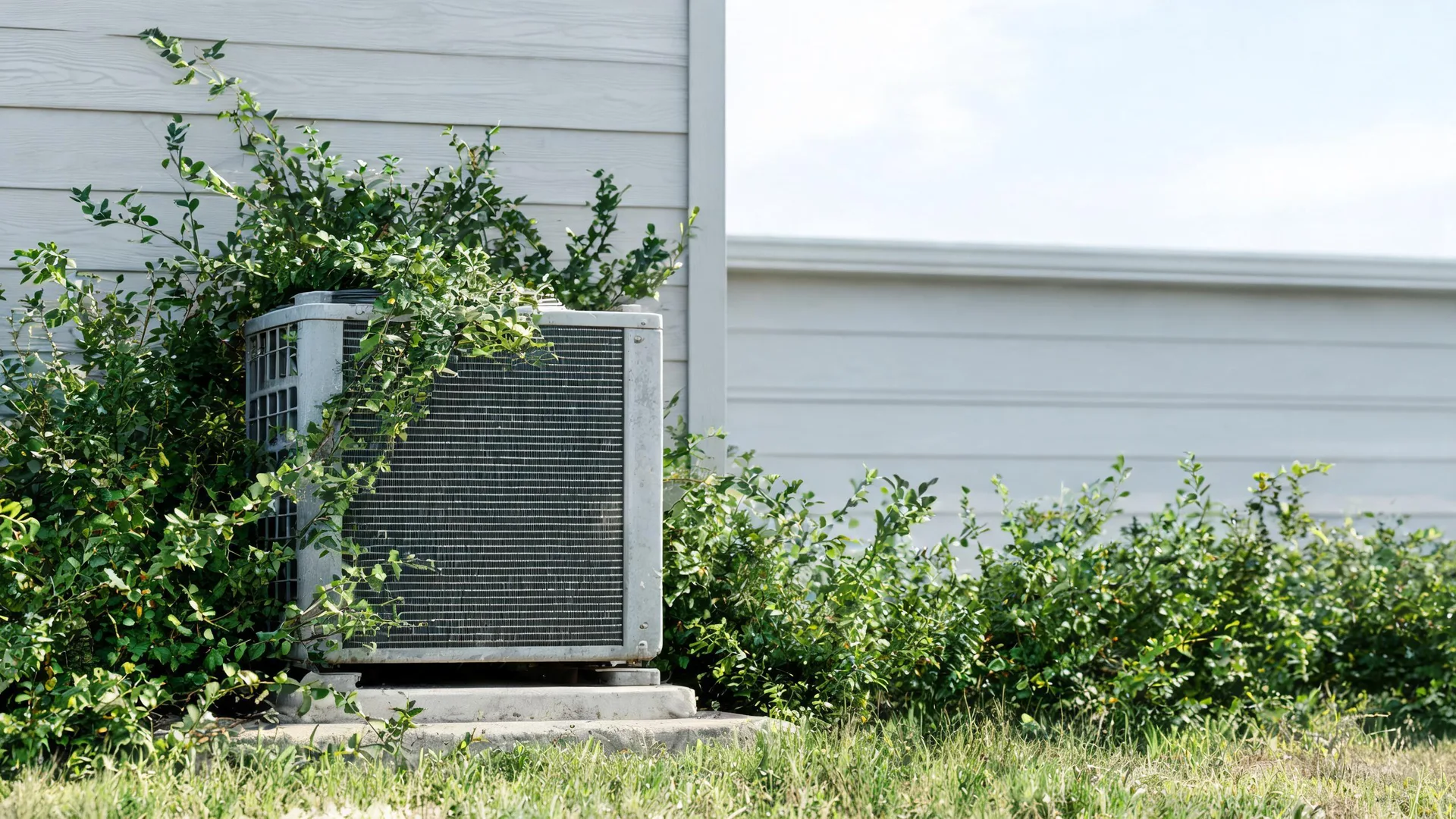
A gray heat pump outdoor unit mounted on a concrete pad next to the stone-accented exterior wall of a house.

What to check before you call anyone

Before you pick up the phone, there are a few things worth looking at yourself. Check the outdoor unit first. If the fins are packed with leaves, grass clippings or ice, airflow is choking and the system is working harder than it should. A garden hose can clear light debris, but bent fins need a tech, not a screwdriver. Next, check your thermostat batteries and settings. A dead battery or a setting bumped to the wrong mode looks exactly like a failed system but costs nothing to rule out. Go inside and check the air filter. A filter clogged with dust restricts airflow through the whole system, and that alone can cause weak heating, weak cooling, or ice forming on the outdoor coil. Replace it if you can't see light through it. Look at the vents throughout the house and make sure none are closed or blocked by furniture. Check your breaker panel too. A heat pump that won't start at all sometimes just needs a tripped breaker reset, though if it trips again right away, stop and leave it alone. If you see ice on the outdoor unit, don't chip at it. Most heat pumps defrost themselves on a cycle, and ice that won't clear points to a problem underneath, not something a hammer should touch. None of these checks fix a failing compressor or a refrigerant leak. What they do is rule out the simple causes so that when a tech does come out, you already know it's something more than a dirty filter or a flipped switch.

What a failing heat pump sounds and feels like

Air coming from the vents that's barely warm or barely cool is the most common complaint, usually from a system low on refrigerant or a compressor that's losing its ability to move heat. Short cycling, where the unit kicks on and off every few minutes instead of running a full cycle, points to a failing sensor or a unit that's overheating and shutting itself down to protect the compressor. Hissing or bubbling near the refrigerant lines means a leak. Grinding or screeching from the outdoor unit usually means a motor bearing is going. Any of these are worth a call, not a wait and see.
Why waiting costs you the compressor

The compressor is the most expensive part in a heat pump, and almost every other failure eventually threatens it. A refrigerant leak left alone means the compressor runs hotter and works harder to move the same amount of heat. A dirty coil or blocked airflow does the same thing from a different angle. The compressor can tolerate strain for a while, which is exactly why people put off calling. By the time it fails outright, the fix that would have been a part replacement becomes a full system decision.

Most heat pump failures trace back to something simple that got ignored. A dirty filter or a coil caked with dirt makes the whole system work harder than it needs to, and that extra strain is what wears out a compressor years before it should quit. Capacitors weaken over time and eventually can't give the compressor or fan motor the jolt it needs to start, so the unit hums but doesn't turn over. A contactor with pitted contacts can stick or fail to close, leaving the outdoor unit silent while the indoor blower runs. Low refrigerant almost always means a leak somewhere in the lines or coil, not normal use, since a sealed system doesn't lose charge on its own. Reversing valves can stick too, and when they do, the system blows the wrong temperature air or won't switch between heating and cooling at all.

Repair makes sense when one part has failed and the rest of the system is still sound. A bad capacitor, a stuck contactor, a worn fan motor, these are straightforward swaps that bring the unit back to full strength. Replacement starts to make more sense when the compressor itself is the problem. It's the most expensive part to replace on its own, and putting a new compressor into an old system often means pairing a new part with a coil and blower that are already worn down. Age matters too, not as a hard cutoff but because the parts around a tired compressor tend to be tired as well. If a tech is finding a new problem every year or two, that pattern says more than any single repair does. A unit that's needed a few small fixes over its life is just a unit that's been maintained. One that keeps failing in different places is telling you it's worn out, not unlucky.