Two illuminated single-story brick ranch houses photographed at night, framed by large oak trees and a wide concrete driveway.

Heat Pump Repair in Guymon, OK

Tell us about the job

Takes about a minute. No obligation.

RepairHeat PumpTexas County, OK
Step 1 of 2

What ZIP code is the job in?

Texas County sees more than its share of storms

Texas County logged 363 severe weather events between 2015 and 2024, with 218 of those damaging wind and 126 hail. Eight tornadoes touched down in that same stretch. A heat pump's outdoor unit sits right in the path of all of it.


Hail and wind can hurt a unit that still seems fine

The outdoor coil and fan are exposed to whatever blows through, and bent fins or a cracked fan blade don't always stop the system from running. If a storm came through recently, that's reason enough to have the unit looked at, even if it's still keeping the house comfortable.

7 months
October through April, your system heats
5 months
May through September, it cools
23°F
the average winter night it heats against
92°F
the average summer afternoon it cools against
Isometric illustration of a cutaway single-story house showing interior ductwork and vents connected to an outdoor condenser unit beside the building, on a white background.
Your system heats October through April and cools May through September.

NOAA nClimDiv, 1991–2020 normals

Hail and wind find the outdoor unit nearly every year here.

A heat pump that takes that kind of hit still needs a real diagnosis, not just a quick look.

October asks the most of a heat pump that's already weak

Cooling runs May through September
Heat runs October through April
218 damaging wind events from 2015 to 2024

If a repair tech turns up and the problem is a bent fan blade or a cracked fin, it's worth asking what caused it, not just getting it bent back. A unit that's taken a hit from hail or wind can keep running for a while with damage that only shows up later as a refrigerant leak or a motor working harder than it should. A proper diagnosis checks the coil, the fan, and the refrigerant charge, not just whether the system turns on. That's the difference between a fix that holds and one that calls someone back out in a month.

If this unit took a hit, get it checked before it has to carry the cold

A quarter of Oklahoma households lost power for a day or more in 2024. When the grid goes down in a Guymon winter, the heat pump has to come back and work, and a bent fin or a hairline crack from an earlier storm is the kind of thing that turns a power cut into a cold house. If hail or wind came through recently, get the unit looked at now, while it's still running fine.

Find a contractor
A gray outdoor HVAC unit mounted on a concrete pad beside a house with gray lap siding and a stone foundation.

What to check before the call

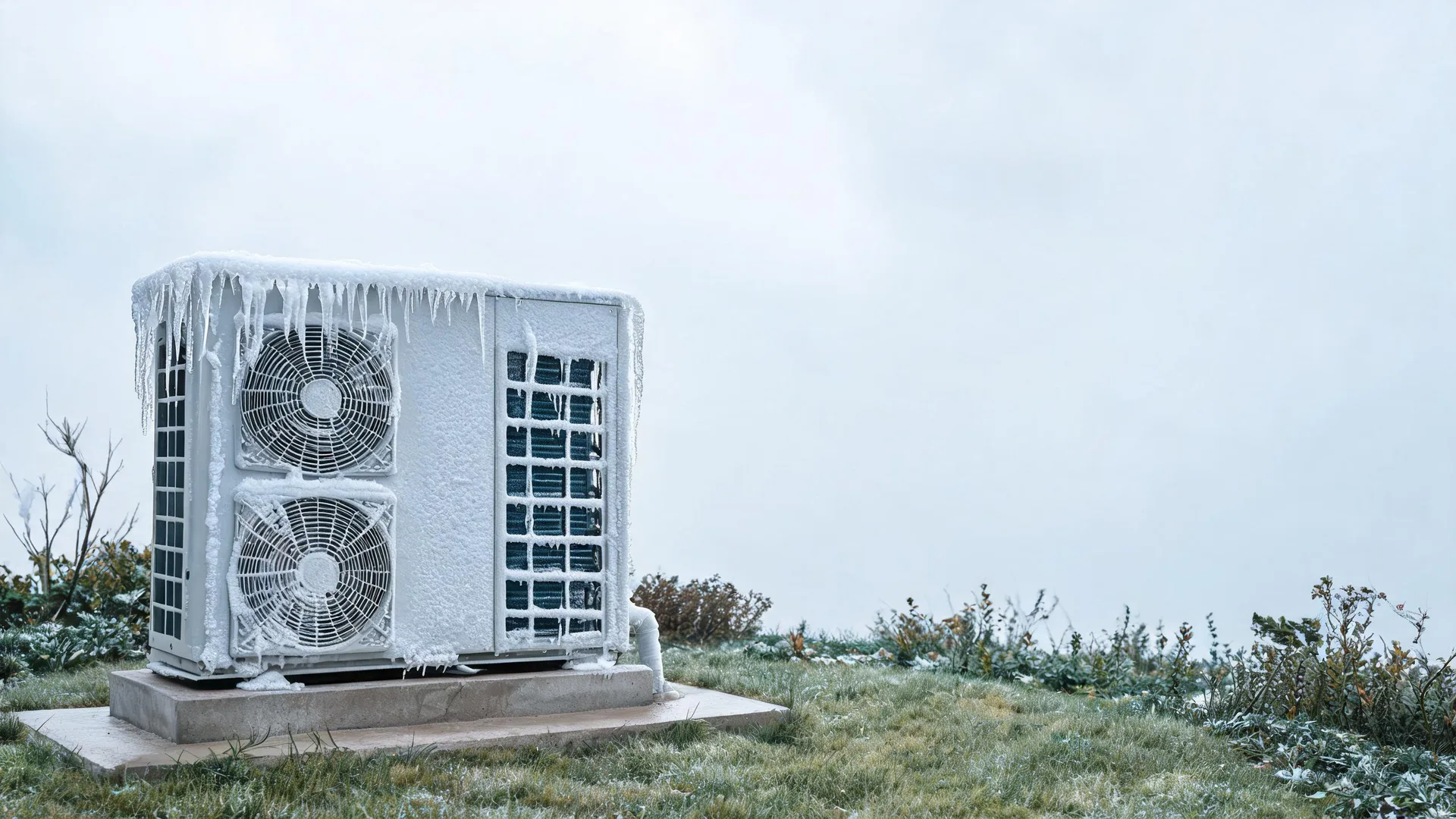
Before calling anyone, look at the outdoor unit itself. Walk around it and check that nothing is blocking the fan or the coil, no leaves, no grass clippings, no ice buildup. Look at the fins on the coil and see if they're bent flat against each other in a way that would stop air from moving through. Check the base the unit sits on and make sure it hasn't shifted or tilted. Inside the house, check the thermostat first. Make sure it's set to heat, not cool, and that the temperature you've set is actually above the current room temperature. A heat pump in defrost mode will blow cool air for a few minutes, and that's normal, not a sign of failure. Check the circuit breaker for both the indoor and outdoor units. A tripped breaker will shut the whole system down without any other warning. Look at the air filter. A filter clogged with dust chokes the airflow across the indoor coil, and that alone can make a heat pump run constantly without heating the house properly. If the outdoor fan isn't spinning at all, don't reach in or try to free it by hand. The same goes for ice on the outdoor coil that isn't clearing on its own after a defrost cycle. Those are jobs for someone who knows the refrigerant side of the system, not something to work on from the outside.

Warm air that isn't warm enough

A heat pump in heating mode should put out air that feels warm at the vent, not just less cold. If the air moving through is barely above room temperature, the system could be low on refrigerant or the reversing valve could be stuck partway. Either one means the unit is running without actually heating the house the way it should.

Short cycling or running nonstop

A heat pump that shuts off a few minutes after starting, over and over, usually has a sensor or control board problem telling it to stop too soon. One that never shuts off and still can't hold the set temperature is losing the fight, often because the compressor is weak or the charge is low. Both patterns point to a system working against itself instead of for the house.

A heat pump that's struggling doesn't fail all at once. A compressor working against a low charge builds heat it shouldn't, and running it for days in that state can wear it out instead of just underperforming. Ice that isn't clearing off the outdoor coil blocks airflow more each hour, and the system respondsby running longer, which only feeds the problem. A cracked fan blade left spinning can let go completely and take the motor with it. None of that gets better by waiting it out. The longer a system runs while something's wrong, the more likely the fix turns into a part that has to be replaced instead of repaired.

A repair tech weighing fix versus replace is really asking one question: is the rest of the system strong enough to be worth saving. An outdoor unit with a few storm dents and a sound compressor is usually worth repairing. A compressor that's been running weak or hot for a long stretch is a different story, because that part failing often means the system as a whole is done, not just that one piece. Age matters less than condition. A heat pump that's been kept clear of ice, had its coil checked after storms, and never run for long periods with a fault showing will hold up through more repairs than one that's been pushed through problem after problem. The question worth asking isn't just what broke, but what else has been quietly working harder because of it.