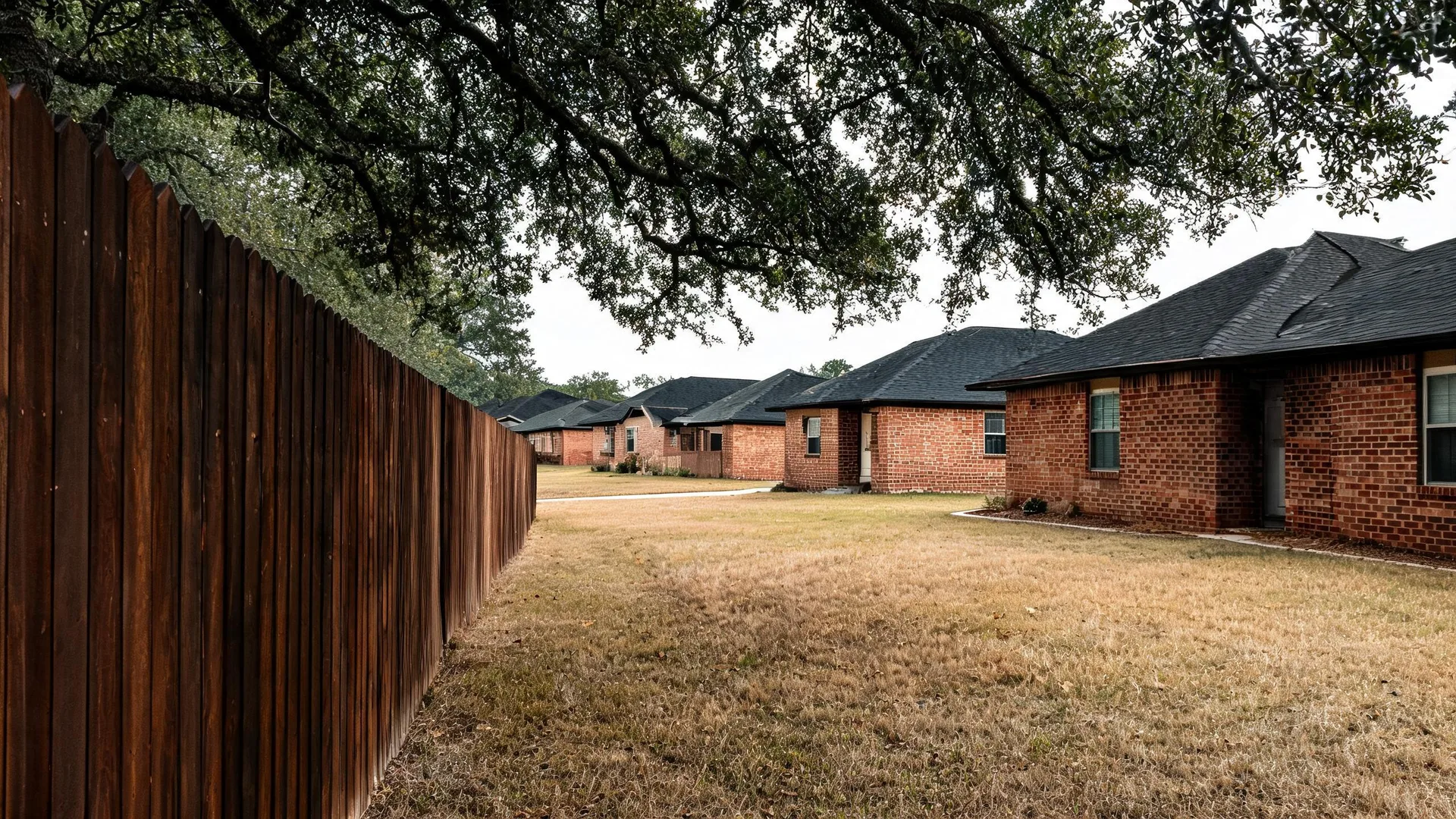
A tall wooden privacy fence runs along the left side of a dry grass yard, with a row of single-story brick houses with dark shingled roofs on the right and oak branches overhead.

Heat Pump Repair in Madill, OK

Tell us about the job

Takes about a minute. No obligation.

RepairHeat PumpMarshall County, OK
Step 1 of 2

What ZIP code is the job in?

Heavy air, long hours

Summer air around Madill sits at a dew point near 67 degrees, heavier than most of the country deals with. A heat pump has to pull more moisture out of air like that, and it runs longer to do it. That extra runtime adds up over a season.


Earlier signs of trouble

A system that runs this much wears into problems sooner than one in a milder climate. A worn part or a refrigerant issue shows up faster here. Getting it diagnosed instead of guessed at is what makes a repair actually hold.

5 months
November through March, your system heats
5 months
May through September, it cools
34°F
the average winter night it heats against
93°F
the average summer afternoon it cools against
Isometric cutaway illustration of a small house showing interior rooms with furniture, an indoor air handler with ductwork, and lines running to an outdoor condenser unit beside the building.
Your system heats November through March and cools May through September.

NOAA nClimDiv, 1991–2020 normals

Half the homes around Madill were built in 1985 or earlier.

A heat pump in a house that old is often on its original ductwork and electrical setup, and the unit itself may be closer to the end of its run than the middle.

Two changeovers a year, and the first cold snap or first heat wave finds the weak part

Cooling runs May through September
Heat runs November through March
Climate zone 3A

If your heat pump is old enough to have come with the house, ask the contractor one more question while they're out: how much life is left in it. A repair on a unit near the end of its run is money spent twice, once now and again soon after. That matters more with a mobile home, where the unit was often sized and installed for that specific setup, and a straight swap isn't always as simple as it is in a site-built house. Get the repair cost next to a realistic read on remaining life before you decide. That's the only way to know if you're fixing it or just delaying the real cost.

Get the real cause found, not just the symptom fixed

That runtime catches up with parts eventually, and when it does, it's rarely obvious which one failed just from the symptoms. A contractor who checks the whole system, not just the part acting up, is what keeps the fix from being temporary.

Find a contractor
A man in a cap, gray long-sleeve shirt and tan pants walks up stone steps toward a dark blue front door, carrying a waxed canvas tool bag in his right hand.
A gray air-source heat pump mounted on a concrete pad next to a house with gray vinyl siding, surrounded by gravel and flanked by green shrubs and white hydrangea flowers.

Why running it longer doesn't buy you time

A heat pump that's struggling doesn't fix itself by staying on. Low refrigerant charge is the clearest case: the system keeps calling for heat or cool, keeps running, and the compressor keeps working against a charge it doesn't have. That's what shortens compressor life, and a compressor is the expensive part to replace. A failing capacitor behaves the same way. It might still start the motor most of the time, but every hard start puts more strain on the motor windings, and a motor that strains repeatedly fails sooner than one that starts clean. Ice on the outdoor coil is another one. A little frost is normal in some conditions, but if something's stopping the defrost cycle from clearing it, the ice builds, airflow drops, and the system works harder to move the same air, which stresses the compressor further. None of these get better with more runtime. They get worse, and they tend to take a healthy part down with them if the system keeps running while the real problem sits there.

What actually wears out

The reversing valve is the part that makes a heat pump different from straight AC, and it takes a beating. Every switch between heating and cooling cycles the valve, and over years that cycling is what causes it to stick or leak. The contactor and capacitor in the outdoor unit wear from simple duty cycles, the compressor starting up and shutting down. A dirty outdoor coil makes the whole system run longer to move the same heat, and that extra strain shortens the life of whatever part was already weakest.

Why it's rarely one thing

A heat pump that stops heating or cooling well is usually the end result of something smaller that went unnoticed. Low refrigerant charge from a slow leak, a sensor reading wrong, a dirty filter restricting airflow. Any one of those makes the system work harder to do the same job, and that extra load is what pushes a weak part to fail. Finding the part that broke is the easy half. Finding what made it fail is what keeps the next part from going the same way.

Before anyone comes out, there are a few things worth checking yourself. Look at the thermostat first. Make sure it's set to the mode you want and the temperature is actually past where the system should kick on. Check the filter next. A filter clogged with dust chokes airflow and can make a heat pump seem like it's failing when it's just starving for air. Walk outside and look at the outdoor unit. Leaves, grass clippings or a cover pushed up against it block airflow the same way a dirty filter does. If you see ice on the outdoor coil, don't knock it off or run a hose on it. Switch the system off and call, since that's usually a sign of something deeper, not something to clear by hand. Check your breaker panel too. A tripped breaker is sometimes the whole story, and it's free to rule out before paying someone to find it for you.

A repair is worth doing when the part that failed is one part and the rest of the system is sound. Swap the capacitor, fix the leak, clean the coil, and a heat pump that's otherwise in good shape goes back to doing its job. Replacement starts to make more sense when you're chasing the second or third failure in a short stretch, because that pattern usually means the system as a whole is wearing down, not just the one part in front of you. An older unit fits that pattern more often, since every part in it has logged the same years of duty cycles, and when one goes the others aren't far behind. A compressor failure is usually the line. Compressors are expensive enough, and central enough to everything else, that replacing one in an older system rarely makes sense next to putting that money toward a new unit. Ask what failed, ask why it failed, and ask what else in the system has seen the same wear. That tells you more than guessing at remaining life on your own.