



An outdoor heat pump unit mounted on a concrete pad in front of a two-story suburban house.

Heat Pump Repair in Ponca City, OK

Tell us about the job

Takes about a minute. No obligation.

RepairHeat PumpKay County, OK
Step 1 of 2

What ZIP code is the job in?

Kay County saw 200 severe weather events between 2015 and 2024, and damaging wind and hail accounted for most of them. A heat pump's outdoor unit sits right in the path of both. Hail dents the cabinet and bends the fins around the coil, and wind-blown debris can do the same or worse. A unit that still runs after a storm isn't necessarily fine. Bent fins restrict airflow across the coil, and a damaged fan blade can wear on the motor long before it fails outright.

7 months
October through April, your system heats
5 months
May through September, it cools
26°F
the average winter night it heats against
91°F
the average summer afternoon it cools against
Isometric line illustration of a cutaway single-story house showing interior rooms, ceiling ductwork, an indoor air handler unit, and an outdoor condenser connected by a line set.
Your system heats October through April and cools May through September.

NOAA nClimDiv, 1991–2020 normals

Half the homes in Kay County were built in 1964 or earlier.

A heat pump that came with a house that old is old too, and may be closer to the end of its life than the start.

Heat pumps start failing in SeptemberHeat runs here from October through April, and the first cold weeks are when a weak unit gives out.

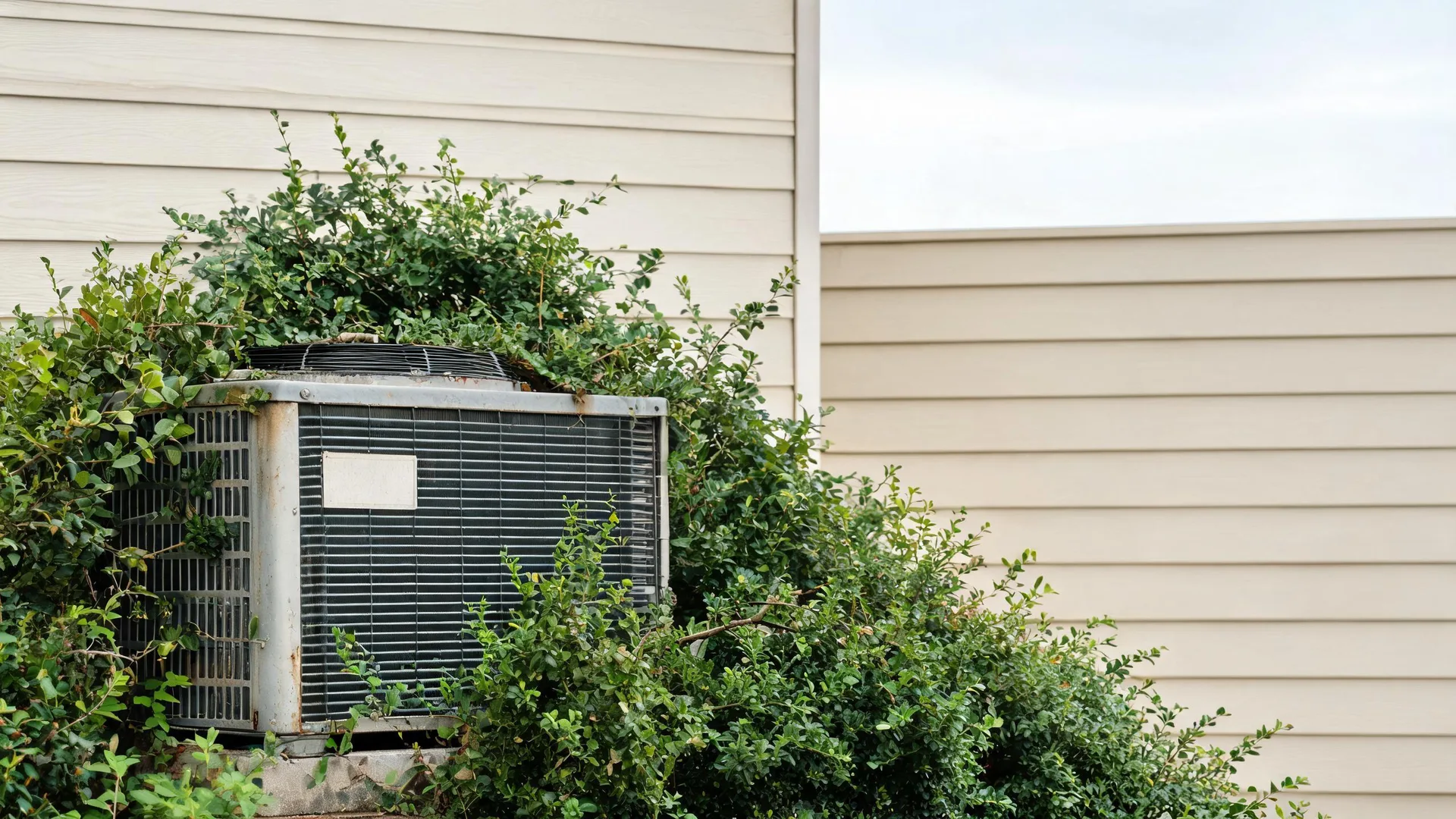
After a storm, look at the outdoor unit before deciding nothing happened. Hail leaves small dents in the cabinet and flattens the fins across the coil, and both are visible if you know to check. A tree limb or loose debris can bend the fan blade just enough to throw it off balance. None of this always stops the unit from running, so a system that kicks on and blows warm or cool air isn't proof it came through clean. A contractor can check the coil and the fan for damage in the same visit as a regular repair call, worth asking for after any storm that brought wind or hail through the area.

This heat pump has sat through 88 hailstorms. Have it checked properly.

Kay County recorded 88 hail events between 2015 and 2024. Your outdoor unit sits outside through every one of them. A dent you can see on the cabinet usually means bent fins you can't, and those restrict airflow across the coil. If it's acting up now, have the coil and fan checked along with whatever repair it needs, so the fix holds.

Find a contractor
A white mini-split heat pump outdoor unit mounted on a concrete pad beside a gray-sided house, surrounded by gravel and green shrubs.

A heat pump works harder than a furnace or an AC

A heat pump runs its reversing valve every time it switches between heating and cooling, and that valve is usually the first thing to wear from the constant back and forth. It can stick partway, and when it does the system runs in the wrong mode or won't switch at all. The outdoor coil takes the next hardest wear. It sits outside through every season, carrying refrigerant that's picking up heat or giving it off depending on which way the system is running, and its fins are thin enough that corrosion or a stray dent cuts into how well it transfers heat. The defrost control is another weak point. It's what tells the unit to melt frost off the coil in cold weather, and if the sensor drifts or the board sticks, ice builds up until the system can't pull any heat from the outside air. Compressors tend to fail last, not first. Something upstream, a low charge or a coil that can't breathe, makes the compressor work harder and run hotter than it should, and by the time it quits it's usually the end of a problem that started somewhere else.

It won't stop cycling on and off

A heat pump that keeps shutting off soon after starting is tripping a safety switch somewhere in the system. A dirty filter, a frozen coil, or a failing sensor can all cause it. Left alone, the constant starting and stopping wears on the compressor every time it happens.
The air coming out isn't warm

Air that feels cool instead of warm doesn't always mean the system has stopped working. A low refrigerant charge or a reversing valve stuck in the wrong position can leave it running without moving much heat. The compressor keeps working the whole time, just without much to show for it.

A heat pump that's struggling doesn't fail all at once. It fails a little, then keeps running, and that's the part that does the damage. A reversing valve that's starting to stick still lets the system run, just in the wrong mode some of the time. A compressor low on charge still turns on, it just works harder to move the same amount of heat, and that extra heat has nowhere to go but through the compressor itself. Ice on the outdoor coil blocks airflow, so the system pulls harder to get the same result, which packs on more ice. None of this stops the unit from running. It just means every hour it runs after that does a little more harm than the hour before, until the part that was struggling is the part that quits.

A repair makes sense when the part that failed is a part on its own, something that can be swapped without the rest of the system paying for it. A capacitor, a contactor, a fan motor. The compressor comes back on, the coil still carries refrigerant the way it should, and the fix holds. Replacement starts to make more sense when the failing part has been dragging on the rest of the system for a while, because a compressor that's been overworking to make up for a bad coil or a low charge is wearing out from something a repair won't touch. Age matters less than what's been happening to the unit. A heat pump that's been running clean and gets hit with one bad part is a different case from one that keeps coming back for the same kind of trouble. The second one is telling you something a single repair won't fix.