

Do you need a furnace humidifier in Oklahoma

Skip the round of in-home estimates for a new furnace.

Skip the search

Do I need a furnace humidifier in Oklahoma

Your heating system dries the air out once the furnace starts running in the winter, and you may have noticed your skin, sinuses or the wood floors acting up by January. You're wondering whether a whole-house humidifier is worth installing, or whether Oklahoma's muggy summers already keep things balanced enough that you don't need one.

Most homes in Oklahoma can get by without one, but it depends on how dry your winters run

A furnace humidifier isn't a requirement here the way it is in colder, drier states. Oklahoma summers are sticky enough that houses don't dry out the way they do in places with long, bone-dry winters. Once the furnace kicks on from November through February, indoor air still gets drier than what you're used to the rest of the year, since heating any air lowers its relative humidity. If you notice static shocks, cracked skin, or gaps opening up in wood trim or flooring during those months, a humidifier tied into your furnace fixes that by adding moisture back as the air moves through the ducts. If none of that bothers you, there's no real need to add one.

A dark high-efficiency furnace on a concrete pad in a basement, connected to galvanized ductwork, white PVC vent pipes, and copper and black gas piping, with concrete walls and wood framing nearby.

With a humidifier running

Dry winter air pulls moisture out of everything in the house, including your sinuses and your floors. A humidifier tied into the furnace puts that moisture back into the same air moving through the ducts, so every room gets it, not just the one with a space unit running.


A gas furnace with a louvered upper panel stands on a concrete pad in a basement, flanked by sheet-metal ductwork, white PVC and metal pipes, and insulated columns.

Without one

The furnace keeps pulling in dry air and pushing it out drier. Static shocks, cracked wood trim, and a scratchy throat by January are what a lot of Oklahoma homeowners deal with once the gas furnace has been running a few weeks straight.

What are you noticing in your house right now

Static shocks every time you touch a doorknob. Your lips or knuckles cracking. A kid or a spouse waking up with a dry throat most mornings in January. Wood floors or cabinet doors showing gaps at the seams that weren't there in the fall. The thermostat says 70 but the house feels colder, so you bump it up a degree or two, and the gas bill follows. None of this means anything is broken. It's what happens to the air once a gas furnace runs for weeks straight without anything putting moisture back into it. Left alone through a full Oklahoma winter, it can mean more cracked trim and tighter-fitting doors every year, and a few more degrees on the thermostat than you'd otherwise need.

A gray-haired man in a dark long-sleeve shirt sits on a gray sofa in a living room, looking toward a sunlit window with sheer curtains.
A gray-haired man in a dark green sweatshirt sits on a sofa in a living room, looking toward a bright window, with a houseplant, lamp, fireplace and framed art behind him.
A gray-haired bearded man in a dark green collared sweater sits on a sofa in a living room with a window, houseplant, floor lamp and bookshelves, looking off to the side.
A gray-haired man in a dark green sweater sits on a sofa in a sunlit living room, looking off to the side, with a framed landscape painting, dining table and shelving behind him.

One form, no calling around

One installer gets your project, so there's no bidding war over it.

Asking costs nothing, and the choice to hire stays yours.

  1. Your furnace blower pulls return air across the humidifier pad or drum.

  2. A small valve feeds water onto the pad as the blower runs.

  3. Warm air absorbs moisture off the pad before entering the ductwork.

  4. A humidistat on the wall cuts the water feed once humidity hits your set level.

An older beige furnace with a louvered vent panel stands on a concrete basement floor beside galvanized sheet-metal ductwork, a metal flue pipe and vertical pipes along a concrete wall.
Before you get your furnace installation
A beige high-efficiency furnace with white PVC vent pipes stands beside galvanized sheet-metal ductwork in a basement with a concrete floor, exposed wood studs, and metal piping along the wall.
After you get your furnace installation
A gray high-efficiency furnace with two PVC vent pipes stands in an unfinished basement beside sheet-metal ductwork, a framed and plastic-covered wall, and a bare concrete wall with vertical pipes.

No humidifier installed

This is a standard setup, the furnace tied into the ducts with nothing added to the air passing through. It heats the house fine, but every cubic foot of air leaving those vents is as dry as what came in. Nothing here corrects for that.

A gray furnace cabinet in a basement, connected to galvanized sheet-metal ductwork and white PVC pipes, against a concrete wall with exposed metal piping and insulation overhead.

Furnace without humidifier, over time

Nothing in this picture is broken. The furnace runs, the ducts carry the heat where it needs to go. But with no humidifier tied in, the dry air it pushes out all winter is the same air drying out your skin, your sinuses and your floors.

Winter nights average 30°F statewide

Nights here run cold enough, all winter, that your furnace is running most of the night just to hold the house steady. That's hour after hour of dry heat moving through the ducts while you sleep, which is why the dryness shows up most by morning.

NOAA nClimDiv 1991-2020 county normals weighted by homes

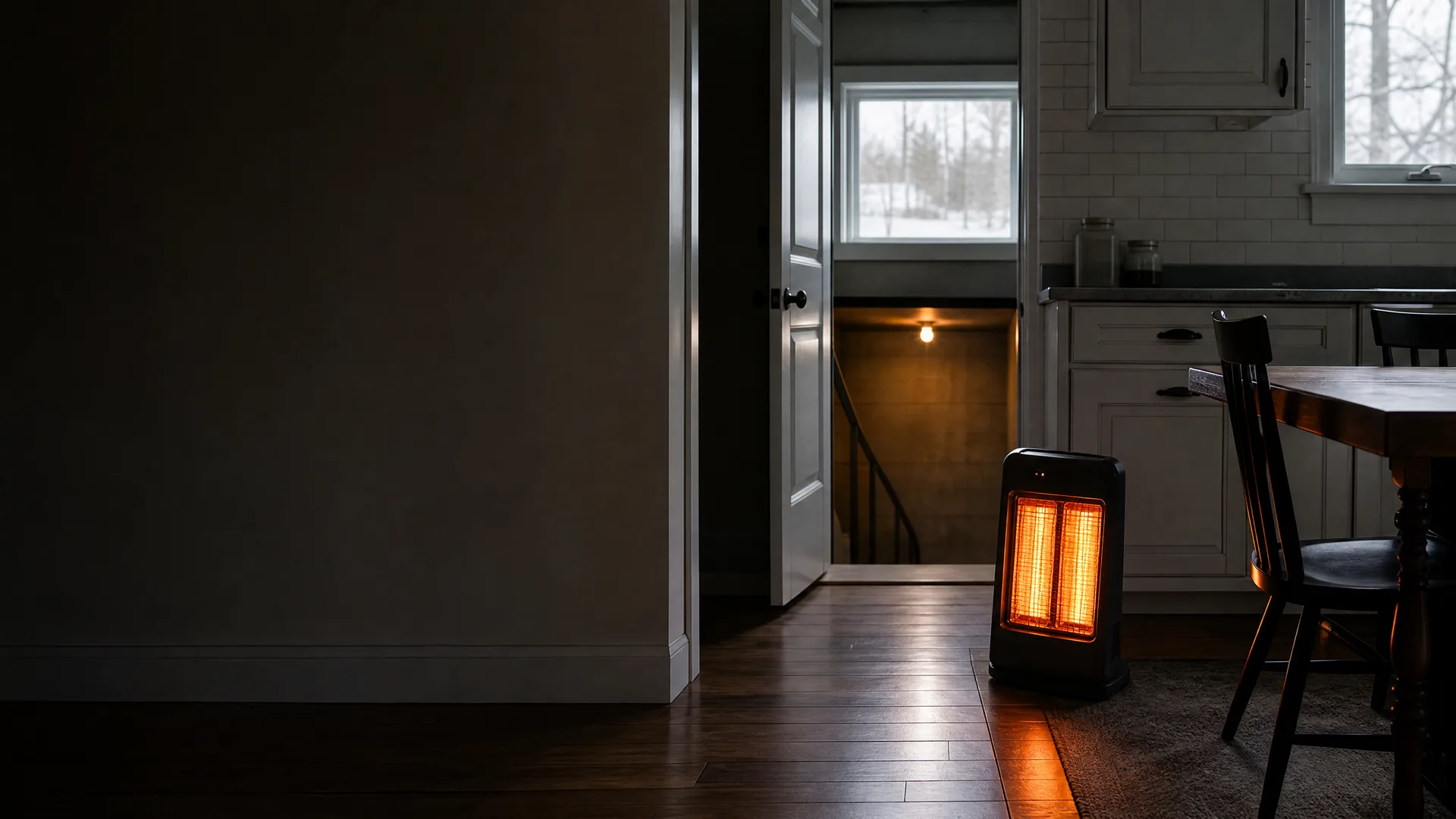
A portable electric space heater with glowing orange elements stands on a dark wood floor in a dim room beside an open door leading to a lit stairway, with a kitchen counter, window and wooden table and chairs at right.

You're up before the rest of the house, and the kitchen is cold enough that you've dragged the space heater over by the table again. It glows orange against the dark, and behind it the basement door sits open, since that's where it lives the other eleven months. Your coffee mug has gone lukewarm faster than it should. Your knuckles feel tight when you wrap them around it. Outside it's still black, the furnace has been running most of the night, and somewhere under the table your socks are sliding on the floorboards like they've gone slick, except it's just how dry the wood's gotten.

A furnace humidifier isn't something you need the way you need the furnace itself, but if the static and the dry skin and the cracking trim are real at your house every winter, it solves the actual problem instead of working around it. The install has to be sized to your furnace and ductwork and wired into the system correctly, including the humidistat that keeps it from overshooting into condensation on your windows. That's a job for someone who installs these on furnaces like yours all winter and knows which models hold up and which valves clog first with Oklahoma water. When you request help through this page, it goes to one licensed local contractor, not a handful of companies competing for the callback, so you're not fielding five calls and comparing five quotes for a job that only needs one good installer. You'll know where you stand on the humidifier question either way. If you decide to move on it, the person doing the work will be someone who already knows this equipment.

A single-story stucco house at dusk with a lit paver walkway lined by low path lights, desert plants and boulders in front, and distant mountains under an orange and blue sky.

Furnace Installation

Skip the search

New system or replacementFurnace or heatingOklahoma
Step 1 of 2

What ZIP code is the job in?

  • A beige upholstered armchair with an olive cushion sits in a sunlit corner beside a wooden side table holding a ceramic vase with leafy branches, under a framed abstract artwork, on a woven rug over a wood floor.
    • A local installer who puts in furnaces gets your project.
    • Get in touch with a local installer about a new furnace.
  • A gray outdoor condenser unit on a concrete pad surrounded by dark gravel, beside a dark wood-sided wall with an electrical disconnect box and a stone veneer wall with a small evergreen shrub.
    • Send the form and the search for an installer is over.
    • Send the request and finding a pro stops being your problem.
  • A beige upholstered oversized armchair with a matching cushion and a knit throw draped over one arm, beside a round wooden side table holding a vase of greenery near a curtained window, with a framed landscape print on the wall and a woven rug on a wood floor.
    • Explain the job once and skip repeating it on every call.
    • Skip searching for a furnace pro and answer a few questions instead.
  • Sunlit living room corner with a beige upholstered sofa, cushion and knitted throw, a round wooden side table holding a white ceramic vase of leafy branches and a small wooden bowl, a framed landscape painting on the wall, and a window at right.
    • Only one pro gets your request, so you hear from one company.
    • Your request stays with one local pro.