Electric heat leads here
Electricity heats 43.2% of homes in Pawnee County, more than gas or propane. Utility gas comes in at 36.0%, and another 14.3% of homes run on bottled or LP gas.
Takes about a minute. No obligation.
Electricity heats 43.2% of homes in Pawnee County, more than gas or propane. Utility gas comes in at 36.0%, and another 14.3% of homes run on bottled or LP gas.
If your furnace runs on the same fuel the house already has lines for, the job is usually simpler. Switching fuel types means bringing in a gas line or electrical capacity that was not there before, which adds to the scope of the work.
NOAA nClimDiv, 1991–2020 normals
Furnaces here start running in October.
Get a new one in before September ends, and it's running on your timeline, not a breakdown.



A standard furnace, sized the normal way for this house, is the right call. Pawnee County gets its share of rough weather, including damaging wind and hail, but none of that changes what a furnace needs to do or how big it needs to be. What it does affect is the power behind it. A quarter of Oklahoma households lost power for 24 hours or more last year, and a furnace with electronic ignition won't run without electricity. Worth asking your contractor how the system handles an outage, and whether a battery backup or generator hookup makes sense for your setup.
Winters here run seven months, October through April, with overnight lows averaging 28°F in December and January. That's steady, ordinary cold, not extreme cold, and a furnace sized the normal way for your house handles it. There's no reason to size up or pay for extra capacity you won't use.
Find a contractorAsk whoever quotes the job to run a load calculation on your house, not a guess based on its square footage or what the last furnace was rated at. That number comes from the walls, the windows, the layout you actually have. In a county where half the homes were built in 1978 or earlier, a contractor who sizes off a rule of thumb is sizing off the wrong house half the time.
An oversized furnace heats the house quickly, then shuts off, then fires again a few minutes later. That short cycling puts more wear on the igniter and the blower motor than a furnace that runs a full, steady cycle. It also leaves rooms farther from the furnace colder than the rest of the house, because the air never runs long enough to even out.
A furnace sized correctly for the house still needs ductwork sized to carry the air it puts out. Ducts built for a different sized unit can leave a new furnace fighting its own supply lines, which shows up as weak airflow in some rooms and a blower that runs louder than it should. Worth having the ducts checked alongside the load calculation, not assumed to be fine as is.
Ask what stage of heat the furnace runs. A single-stage furnace fires at one output every time, full blast, then shuts off. A furnace that can step down to a lower flame for most calls for heat runs longer, gentler cycles and holds a room's temperature steadier. Ask what the blower motor is too, since a motor that adjusts its speed to match the call for heat behaves differently than one that just runs at a fixed setting whenever it's on. Ask about the warranty on the heat exchanger by name, not just the unit as a whole. That part is the most expensive to replace and the hardest to get to once the furnace is installed. And ask who is actually doing the installation, because a furnace only performs as well as the ductwork and venting it gets connected to.
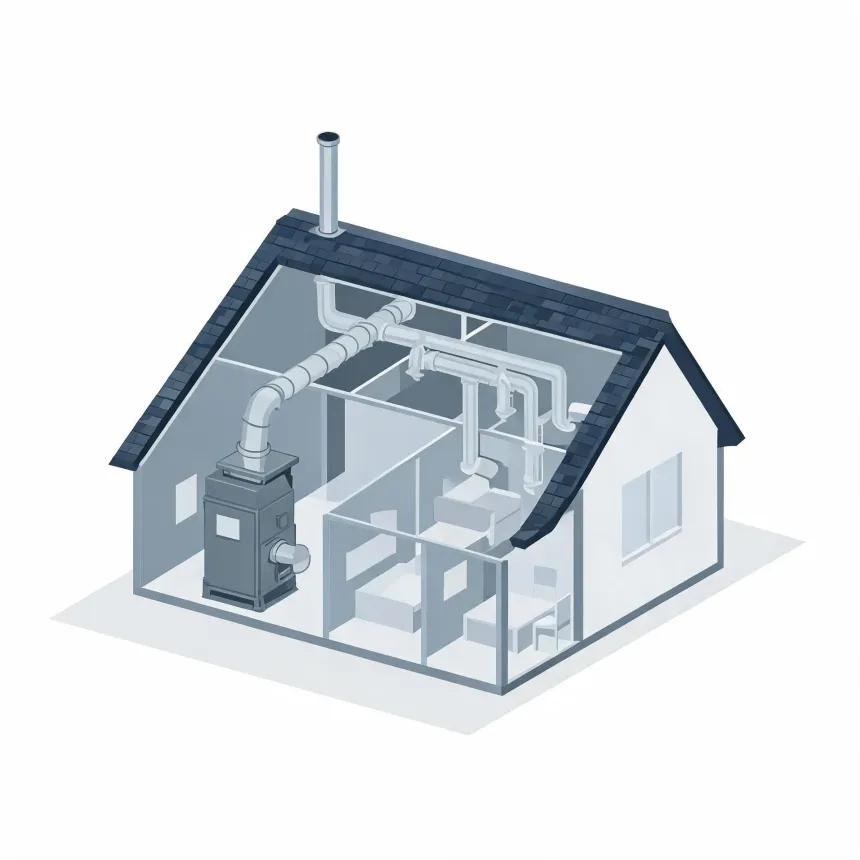
Install day starts with the old furnace coming out, and that part is often slower than putting the new one in, especially if the vent pipe or gas line has to be rerouted to fit the new unit's connections. The new furnace gets set in place. Then it gets hooked to the ductwork, the gas or electric supply, and the venting that carries exhaust out of the house. Each connection gets tested before the job is called done. A gas furnace gets checked for leaks at every joint, not just lit and left. The venting gets checked for proper slope and clearance, since exhaust that doesn't draft right can back up into the house. Once it's running, a tech should check the temperature rise across the furnace and confirm the blower is moving the right amount of air, not just that heat is coming out of the vents.