Storms come through often
Delaware County logged 117 severe weather events between 2015 and 2024, including 47 damaging wind events, 40 hail events and 18 tornadoes. Any of these can hit the outdoor parts of a heating system.
Takes about a minute. No obligation.
Delaware County logged 117 severe weather events between 2015 and 2024, including 47 damaging wind events, 40 hail events and 18 tornadoes. Any of these can hit the outdoor parts of a heating system.
A quarter of Oklahoma households went at least 24 hours without power in 2024. A furnace that depends on electricity to run, even a gas one, needs the parts that start it and move the air to be in good shape before the next outage.
NOAA nClimDiv, 1991–2020 normals
A furnace that loses power mid-cycle has to relight and restart clean every time service comes back.
A weak igniter or a failing control board may not survive enough of those restarts to keep up.



Before you call anyone, check the thermostat first. Make sure it's set to heat and not fan only, and set the temperature a good bit above room temperature so it actually calls for heat. Next, go look at the air filter. A filter clogged with dust chokes off airflow, and a lot of furnaces will shut themselves down rather than run with no air moving across the heat exchanger. If you've got a standing pilot, check that it's still lit. If yours has an electronic igniter instead, look for a blinking light on the control board behind the access panel. That blink pattern usually points to a specific fault, and the panel itself or the manual that came with the unit will tell you what the pattern means. Check your breaker panel too. Furnaces trip breakers sometimes, and a reset is free. Last thing worth checking is the vent pipe outside. If it's blocked by anything, the furnace may be shutting itself off on purpose as a safety measure rather than failing on its own.
Hail and wind have hit this county dozens of times over the past several years, and the outdoor parts of a furnace sit right in their path. A unit that still runs after a storm can have a dented cabinet or a damaged fan blade that only shows up as a failure later, often on the coldest night. Have it checked now, while it's still working, instead of after it quits.
Find a contractor
A furnace that's struggling still tries to do its job, and that's the problem. A cracked heat exchanger gets a little worse every time it heats up and cools down. A blower motor with worn bearings keeps spinning until it seizes, instead of failing gently. An igniter that's cracking runs hotter and hotter near the break until it finally snaps. None of these get better on their own, and running the furnace through them doesn't give them a chance to. A limit switch tripping and resetting over and over is the furnace telling you airflow isn't right, not a glitch to ignore. Keep running it past that point and you're often trading a part replacement now for a cracked heat exchanger later, which is a different conversation entirely.
A furnace that fires up, runs a couple minutes, then shuts off before the house warms is tripping on its own safety switch. A flame sensor coated with residue, a limit switch reacting to poor airflow, or a cracked heat exchanger can all cause this. The furnace isn't being temperamental. Something inside it is telling it to stop.
A furnace that bangs when it starts is usually delaying ignition, letting gas build up before it catches. A screech points to a motor bearing going dry. A rhythmic scrape means something is rubbing against the blower wheel. These sounds mark the start of a failure, not the middle of one, and the part rarely fixes itself quietly.
A furnace is worth fixing when the problem is one part acting up inside a cabinet that's otherwise sound. A failed igniter, a bad flame sensor, a blower motor on its way out, these get swapped and the furnace runs like it did before. What changes the math is the heat exchanger. That's the part that actually cracks or rusts through with age, and once it's compromised the whole unit gets replaced rather than repaired, because that's the part that keeps combustion gases separate from the air moving through your house. Age matters too, not as a number but as a pattern. A furnace that's needed a few different repairs over a few different years is a furnace whose other parts are the same age as the one that just failed, so fixing today's problem just buys time until the next one. If a contractor tells you the heat exchanger is cracked, that's not a repair worth doing. Everything else usually is.
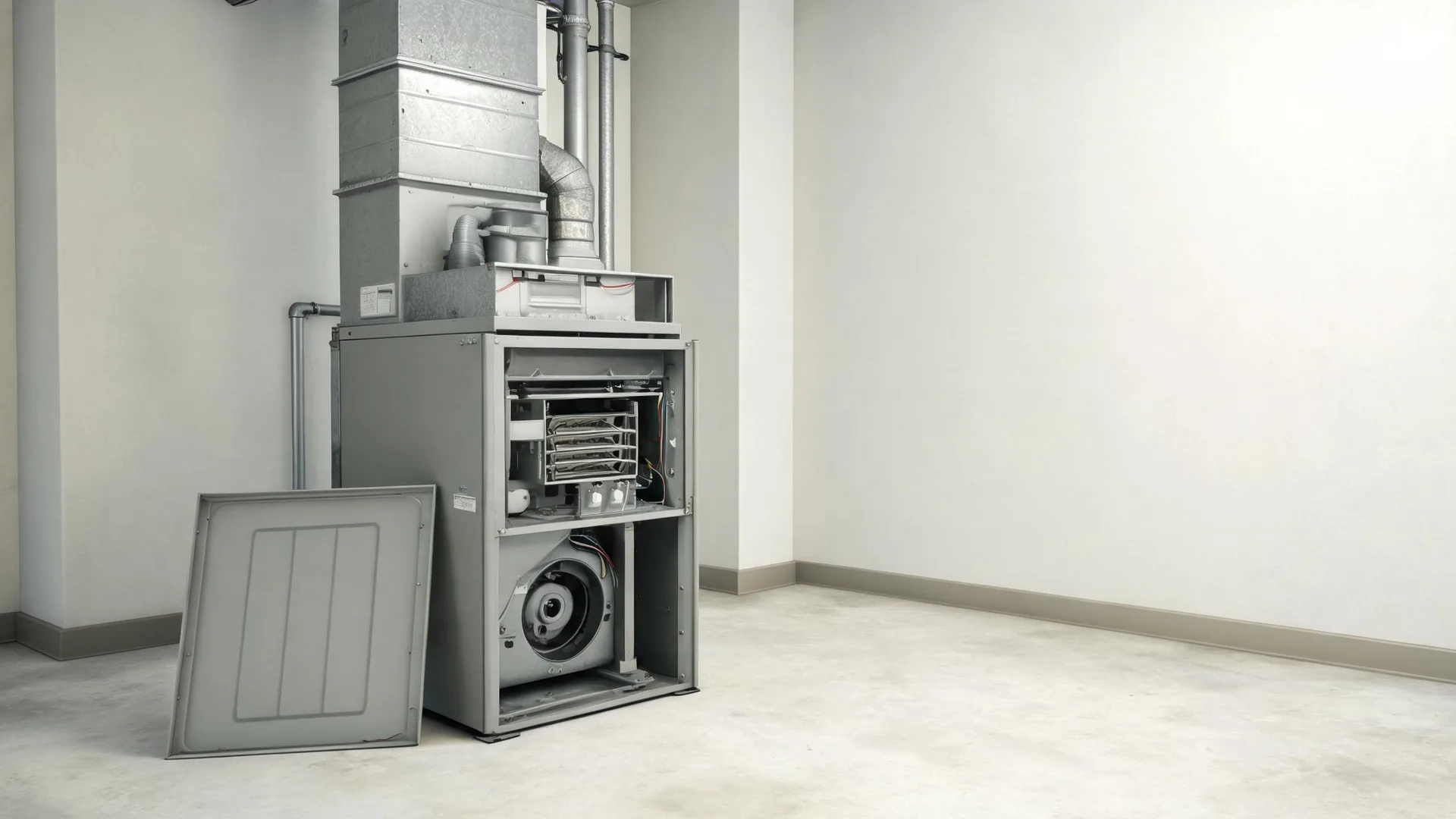
A diagnostic visit starts before the panels come off. A tech will ask what the furnace was doing right before it quit, since a bang on startup points somewhere different than a short cycle or a dead blower. Then the covers come off and the tech checks for a fault code or blink pattern on the control board, because that narrows down which part to test first instead of guessing. From there it's a meter on the parts most likely to fail: the igniter for resistance, the flame sensor for a clean signal, the limit switches for continuity. Airflow gets checked too, since a clogged filter or blocked vent can trip the same safeties as a bad part and look identical from the thermostat. The visit ends with the tech telling you which part failed and why, not just that something did.