





A twilight view of single-story brick homes on a suburban street, lit by warm amber landscape spotlights that illuminate the facades and surrounding trees.

Furnace Repair in Tulsa, OK

Tell us about the job

Takes about a minute. No obligation.

RepairFurnace or heatingTulsa County, OK
Step 1 of 2

What ZIP code is the job in?

Tulsa County saw 525 severe weather events between 2015 and 2024. That includes 276 damaging wind events, 215 hail events and 22 tornadoes. A furnace shares the house with whatever the roof and siding went through, and a lot of that weather brings power loss along with it. Statewide, a quarter of Oklahoma households went at least a full day without electricity in 2024. A furnace needs power to run even on gas, for the blower and the control board, so an outage means no heat regardless of what's in the tank or the line. None of that tells you what your own system has been through, but it's worth knowing what's common here before you decide a strange noise or a short cycle can wait.

7 months
October through April, your furnace is on duty
29°F
the average winter night it heats against
62%
of homes here heat with gas, so most furnaces here burn gas
10 winter storms
in ten years, the nights a failure hurts most
Isometric grayscale illustration of a cutaway single-story house showing interior rooms with furniture, a furnace unit connected to ductwork and a tall vertical flue pipe extending above the roof.
Your furnace works hardest from November through March.

NOAA nClimDiv, 1991–2020 normals

A furnace that short cycles is shutting itself off before the house gets warm.

Left alone, that pattern wears on the parts that are already struggling to keep up.

Half the furnaces here are newer than the storms that hit them

Half the homes here were built by 1979
Heat runs October through April
Winter nights average 29°F
Heat starts in October hereFurnaces in Tulsa County run from October through April, and trouble usually shows up in that first month.

If your furnace came with the house, check when that was. Half the homes in Tulsa County were built in 1979 or later, which means a lot of furnaces here are well within their working life, not relics that happened to survive a bad winter. That matters for what you do next. A newer system that trips off, short cycles, or won't restart after an outage is usually failing at one part, a pressure switch, a flame sensor, a control board that didn't like the power surge. That's worth fixing. It's a different call than a furnace that was already old before the storms started piling up. Either way, the house being new doesn't tell you what the system inside it has actually been through, so it's worth having someone look before you guess.

If a storm got to your furnace, find out now

A furnace that got knocked out by wind, hail or a power surge does not always announce it. Sometimes it just starts short cycling or won't fire at all a few weeks later. If your system took on a storm this year, or sat through an outage, it is worth having someone look at it before the cold settles in for good.

Find a contractor
A gray residential gas furnace installed in an unfinished basement, connected to sheet-metal ductwork and PVC pipes.

What to check before you pick up the phone

Before calling anyone, cut power to the furnace at the switch and check the filter. A filter clogged with dust chokes airflow, and that alone can make the burners shut off early or the system blow cold air in spurts. Next look at the thermostat. A dead battery or a setting bumped to the wrong mode causes more dead-furnace calls than people expect. Check that the door panel is seated all the way, since most furnaces have a safety switch that keeps the blower from running if the panel is loose or off. Look at the vent pipe outside where it exits the house and make sure nothing is blocking it, no nest, no debris, no snow packed against it. If the furnace has a standing pilot, see if it's lit. If it uses an electronic igniter instead, you'll likely hear it try to fire, and a clicking sound with no flame usually means the igniter or the flame sensor needs attention, not something to handle yourself. Check any reset button on the blower motor, usually a small red button on the housing, and press it once. If it trips again right away, stop and leave that to someone who can test the motor. None of this fixes a cracked heat exchanger or a failed control board, but it rules out the simple things first.

A small problem can start pulling on bigger parts

A furnace that's struggling, whether from a dirty flame sensor, a weak inducer motor or restricted airflow, doesn't fail all at once. It keeps trying to do the job with less than it needs. The blower runs longer to push the same heat through the house. The igniter fires again and again because the flame sensor isn't holding the signal. Heat builds where it shouldn't, in the heat exchanger or around the control board, because the system meant to carry it away is the same one that's failing. Every cycle after that asks more of parts that are already behind.

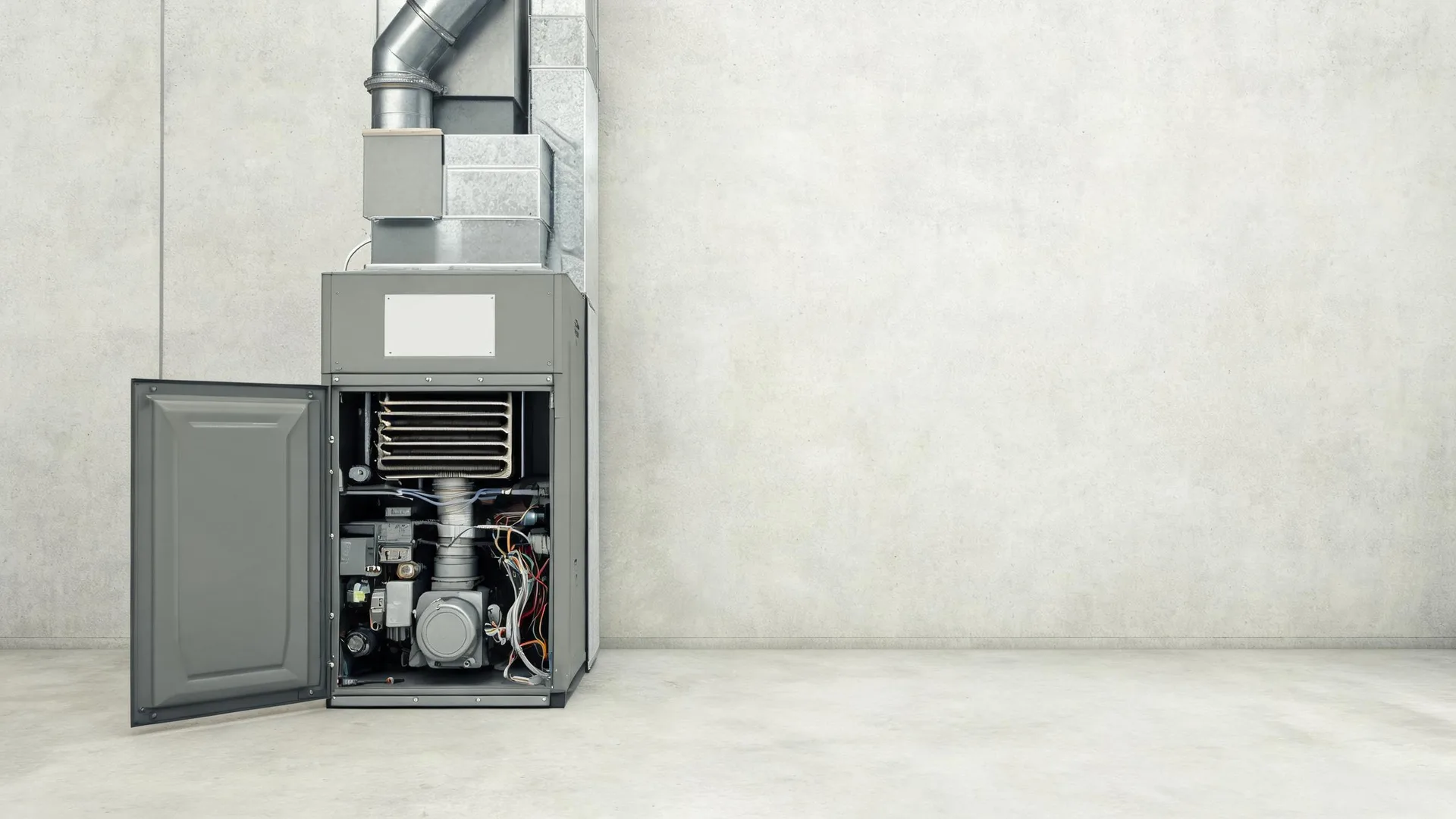
Running it anyway can turn a repair into a replacement

A cracked heat exchanger almost always starts as something smaller that got ignored, usually a system that was overheating on a regular basis. A failing blower motor that keeps drawing current past its limit can take the control board down with it. A furnace that's short cycling because of a clogged filter will eventually scorch the heat exchanger from the extra heat it can't vent fast enough. None of that happens on the first bad cycle. It happens over the cycles that run after someone decides the noise or the smell can wait.

A gray forced-air furnace with metal ductwork stands in an unfinished basement with exposed wooden joists, concrete walls, and a single hanging light bulb.

A new furnace would cut about $110 a year off heating for a typical Tulsa County home.

  • A new high-efficiency furnace$490 a year
  • An older furnace$600 a year

Estimates for a typical Tulsa County home, compared with an older unit built to the previous federal minimum, from EIA household energy data, Oklahoma fuel prices and NOAA climate normals. Your home will differ.

Repair makes sense when one part has failed and the heat exchanger is sound.

Replacement makes sense when the heat exchanger is cracked or the furnace keeps needing parts.

At some point the question stops being what's wrong and starts being whether it's worth fixing at all. Age is part of it, but not the only part. A furnace that's needed three or four service calls in as many years is telling you something even if each call was a small fix. The heat exchanger matters most, because that's the part that can't really be repaired. If a technician finds a crack there, replacement is the honest answer, not a patch. Everything else on a furnace, the igniter, the blower motor, the control board, the pressure switch, can be swapped out on its own without touching the rest of the system. The real question to ask is whether the repairs keep solving different problems or the same one coming back. A furnace that keeps tripping on the same fault after it's been fixed is wearing out from the inside, even if each individual part tests fine on its own.