






A tall wooden privacy fence runs along the left side of a dry grass strip, with a row of single-story brick houses and large spreading oak trees on the right under an overcast sky.

Heat Pump Installation in Kingfisher, OK

Tell us about the job

Takes about a minute. No obligation.

New system or replacementHeat PumpKingfisher County, OK
Step 1 of 2

What ZIP code is the job in?

Kingfisher County logged 124 severe weather events between 2015 and 2024. Hail accounted for 52 of those, damaging wind for 50, and 13 tornadoes touched down. A heat pump's outdoor unit sits through all of it, exposed to whatever hail and wind pass over the property. Winter adds its own risk, with 9 ice and snow storms in that same span. And when the power goes, it goes for a while: a quarter of Oklahoma households were without power for at least 24 hours in 2024. A heat pump here has to hold up to the weather it sits in, and the home still needs a plan for heat and hot water when the lines go down.

7 months
October through April, your system heats
5 months
May through September, it cools
28°F
the average winter night it heats against
93°F
the average summer afternoon it cools against
Isometric line illustration of a cutaway house showing interior rooms with furniture, ceiling ductwork connected to an indoor air handler, and an outdoor condenser unit linked by refrigerant lines.
Your system heats October through April and cools May through September.

NOAA nClimDiv, 1991–2020 normals

Gas heats 45.5% of homes in Kingfisher County, more than electricity or propane combined.

A heat pump replacing a gas furnace here usually needs new electrical work, not a straight swap.

Cheap power here means payback isn't the point

Power here costs 12.37 cents per kilowatt-hour
52 hail events from 2015 to 2024
Climate zone 3A
Get it in before OctoberHeat runs here from October through April, seven months on that system

Hail falls on the outdoor unit the same as it falls on the roof, and the unit has no cover to sit under. Kingfisher County logged 52 hail events between 2015 and 2024, so that's not a rare risk here. Summer brings a different kind of load. The dew point averages 65°F across June, July and August, which is heavy, sticky air, and a heat pump has to pull that moisture out all day to keep a house feeling dry. More hours of work each summer means the compressor and the fan motor earn their keep sooner than they would in a milder climate. A unit built for this has to handle both, the weather outside and the moisture inside, without cutting corners on either.

Plan the install around the weather it has to survive

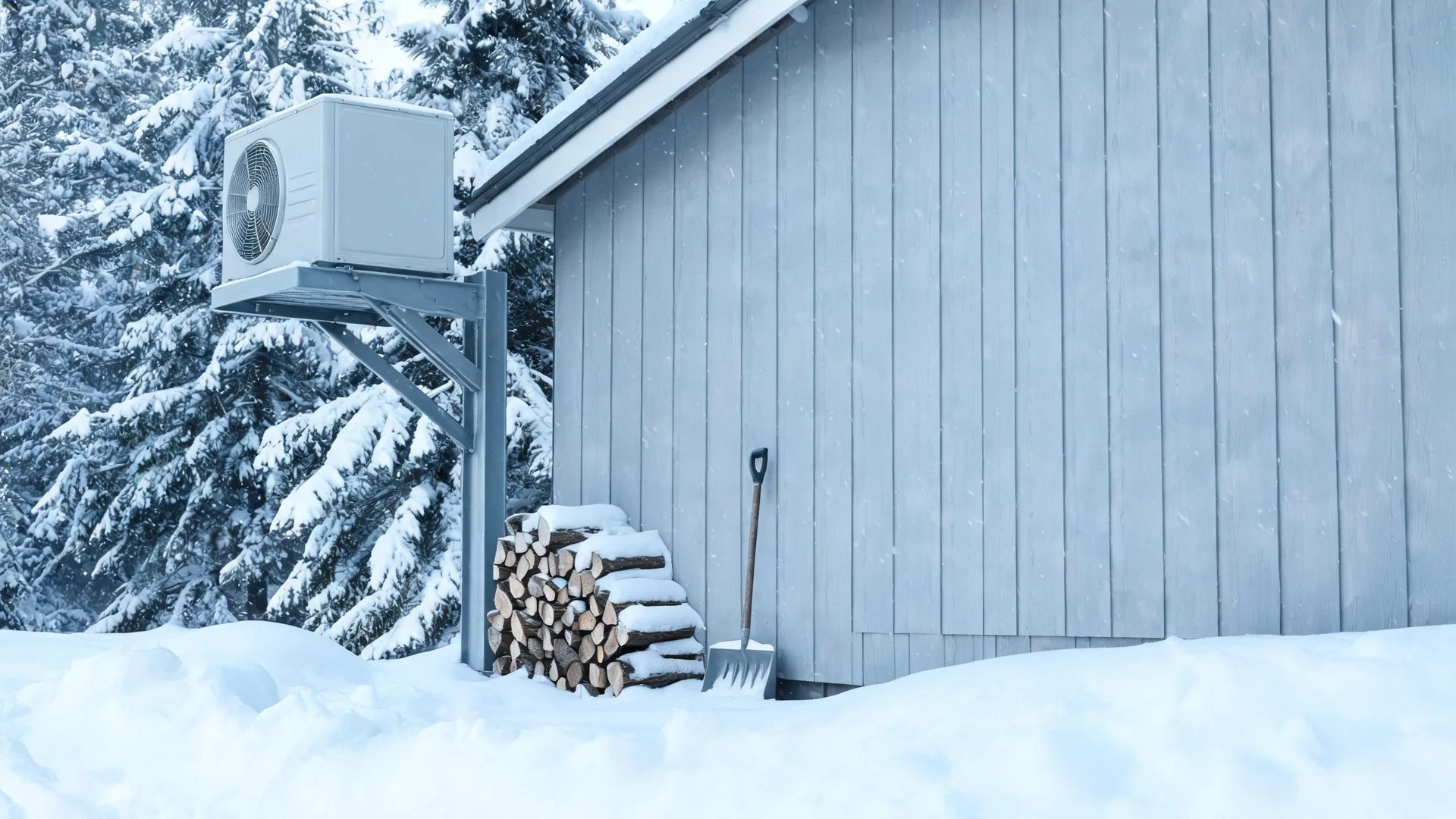
Where the outdoor unit goes and what sits between it and the yard is worth deciding before install, not after a storm. And since the power here doesn't always hold through one, ask what backs up the system for heat and hot water when it's out for a day or more.

Find a contractor
A man in a cap, dark shirt and tan work pants, seen from behind, carries a worn canvas tool bag up steps toward a dark blue front door beside a tall planter of flowers.
A dark gray heat pump unit mounted on a concrete pad next to a house with gray siding and a stone veneer wall.

What actually happens on install day

Install day starts with the old equipment coming out, and the new unit doesn't go in until that's done and the site is ready for it. The line set gets run between the indoor coil and the outdoor unit, and if it's a straight swap those lines may already have a path to follow. New lines get pressure tested before anything is charged, because a leak found after the fact means pulling the system apart again. The electrical work usually takes as long as the mechanical work, since a heat pump draws differently than a furnace and the disconnect, breaker and wiring all have to match what the new unit calls for. Once the outdoor unit is set on its pad and the indoor coil is in place, the system gets charged with refrigerant to the exact amount the manufacturer specifies, not just until it feels cold. Then it runs. A tech checks the temperature split across the indoor coil, checks the pressures on both the high and low side, and listens for anything that shouldn't be there. The thermostat gets set up last, and if it's a smart model it usually needs its own configuration before it reads the system correctly. A good install ends with someone walking the homeowner through the thermostat and explaining what the system sounds like when it's running normally, so the first strange noise months later isn't a surprise.

The equipment is only half the bid

Two contractors can quote the same outdoor unit and land far apart on price, because the line set run, the electrical panel work, and the pad or mounting all change with the property. A straight swap costs less labor than a system going somewhere new, since the refrigerant lines and wiring already have a path to follow.
Sizing takes more than square footage

A heat pump sized off a load calculation, not just the size of the old furnace, costs more to quote right because it takes someone's time to measure the house, not guess at it. Oversized equipment cycles too fast and never pulls humidity out of the air. Undersized equipment runs constantly and still falls short on the coldest and hottest days, so the right size is worth paying for even when it's not the cheapest number on the page.

Taking out the old system is part of the job, not an afterthought. If a furnace is coming out alongside gas lines being capped, that work has to be done by someone licensed to handle gas, and it has to happen before the new heat pump goes in, not after. An old condenser or heat pump gets its refrigerant recovered, not vented, since venting refrigerant is against the law and bad practice both. Ductwork usually stays, but it gets checked first. A system sized for a furnace doesn't always move the right amount of air for a heat pump, and leaky or undersized ducts will undercut even a well-chosen unit. The old disconnect box and pad by the condenser often get reused or replaced depending on their condition, and the electrician working the job will say which. None of this is hard to do right, but it's easy to do fast and wrong, and a rushed removal is usually what turns into a problem later.

Kingfisher County falls in zone 3A, the warm humid band under the 2021 energy code. Any heat pump installed here has to hit 14.3 SEER2 for cooling and 7.5 HSPF2 for heating, the federal minimums that took effect in 2023. Central air systems installed in this region face a similar floor, 14.3 SEER2 under 45,000 Btu/h and 13.8 at or above it, higher than what the rest of the country requires. These numbers set the bottom of what a contractor can legally sell and install, not a target to aim for. A system priced below that floor isn't on the table here, whatever the sticker says.