







Three white clapboard houses with wraparound porches glow with warm interior and landscape lighting beneath Spanish moss-draped oak trees at dusk.

Heat Pump Installation in Idabel, OK

Tell us about the job

Takes about a minute. No obligation.

New system or replacementHeat PumpMcCurtain County, OK
Step 1 of 2

What ZIP code is the job in?

McCurtain County saw 207 severe weather events between 2015 and 2024. That includes 112 damaging wind events, 74 hail events, and 15 tornadoes. A heat pump's outdoor unit sits outside year round, so it takes whatever comes through: hail dents the cabinet fins, wind throws branches and debris into the coil. Statewide, a quarter of Oklahoma households went at least a day without power in 2024. A heat pump needs electricity to run, for heat as much as for cooling, so an outage here isn't just an inconvenience. Where the unit goes and how it's protected matters more in a county like this than in most places.

6 months
November through April, your system heats
5 months
May through September, it cools
33°F
the average winter night it heats against
91°F
the average summer afternoon it cools against
Isometric cutaway illustration of a single-story house showing interior rooms, attic ductwork and an air handler, with an outdoor condenser unit connected by lines along the exterior wall.
Your system heats November through April and cools May through September.

NOAA nClimDiv, 1991–2020 normals

Almost 7 in 10 homes in McCurtain County heat with electricity.

A heat pump fits that setup already, so installing one here means working with the wiring and layout most houses have, not against it.

Two seasons of work a year leaves a short window to get this done right

Cooling runs May through September
Heat runs November through April
112 damaging wind events from 2015 to 2024
Electricity here runs cheapIdabel homes paid 13.92 cents per kilowatt-hour in 2025, so picking the most efficient model matters less than picking one that keeps running.

Humidity is the other load this system carries. Dew points here average 68°F through June, July and August, higher than most of the country sees, and that moisture is what a heat pump has to pull out of the air along with the heat. The outdoor unit runs longer hours to do it than it would in a drier county. That's a sizing question more than a shopping question. A unit matched to this kind of load keeps up without straining. One sized for an easier climate runs harder than it was built to, summer after summer, and that strain is what shortens the life of the parts inside it.

Plan for where the unit sits and how you'll stay warm without it

Installing a new heat pump is the chance to decide where the outdoor unit goes and what shields it, and to work out a backup for heat and hot water before an outage, not during one.

Find a contractor
A man in a dark long-sleeve shirt and tan work pants carries a canvas tool bag up porch steps toward a navy blue front door, with a potted shrub beside the entry.
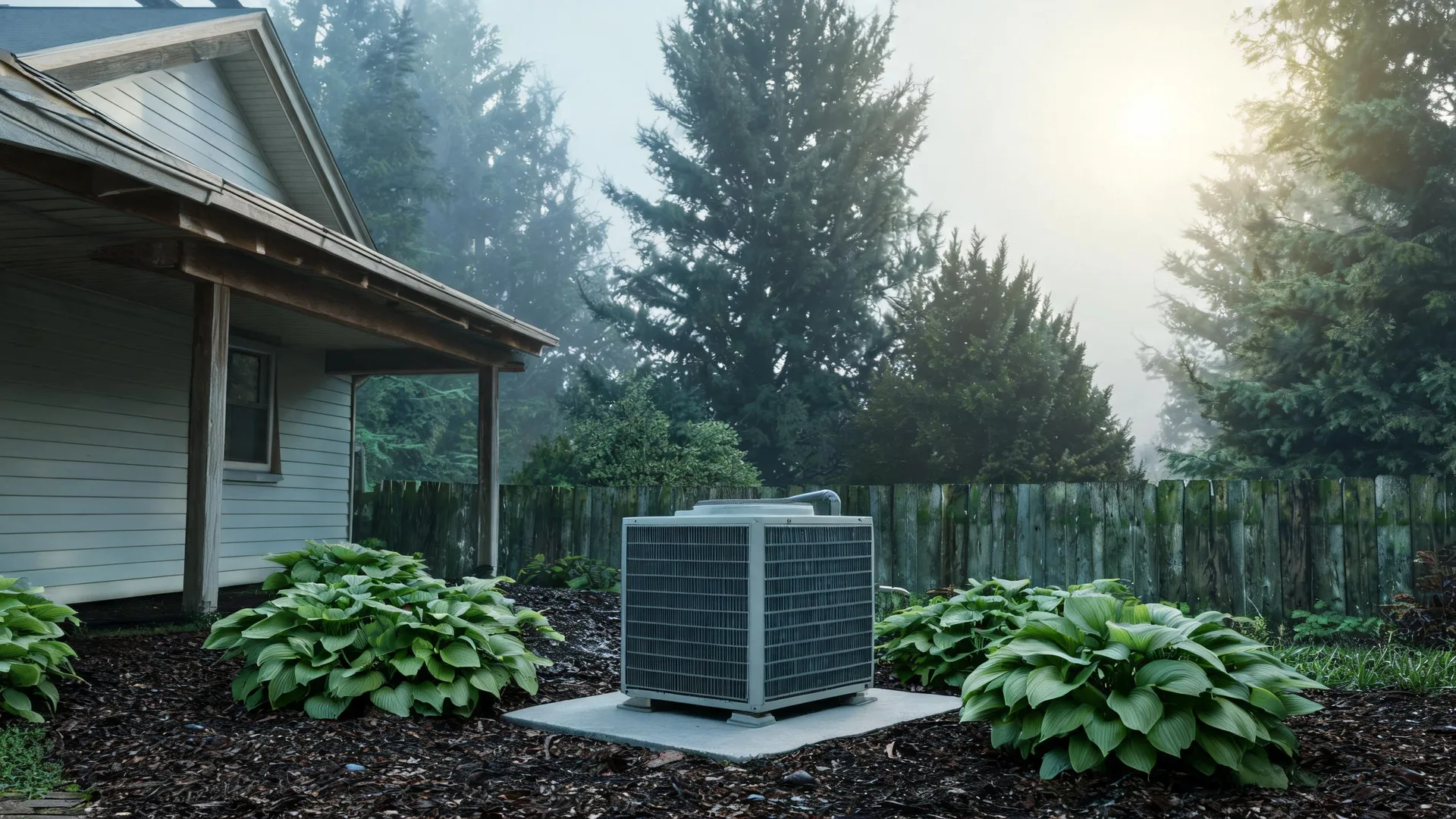
A gray heat pump condenser unit mounted on a concrete pad against the gray lap-siding exterior wall of a house.

The number on the label is a starting point, not the whole story

The rating on the label comes from a lab test, one unit cycling on and off under mild, controlled conditions. It's useful for comparing one model against another, but it won't tell you how that unit behaves on the coldest night of the year or through a long stretch of heat and humidity with no break. A heat pump that runs hard most months it's installed is doing a different job than one that gets to cycle on and off in easy weather. What decides how it actually performs is sizing, how the ducts move air through the house, and how well the refrigerant charge is set once it's in place. Two homeowners can buy the same rated system and end up with different results, because the installation is what makes that rating hold up or not.

Bigger isn't better

A heat pump that's too big for the house cools the air fast and shuts off before it pulls the moisture out, so the house feels clammy even at the right temperature. It also cycles on and off more than it should, and that stop-start wears on the compressor over time. Too small, and it runs flat out on the coldest and hottest days without ever catching up. The right size isn't the biggest unit that fits the budget. It's the one matched to the house.
The load calculation does the real work

A contractor works out the size with a room by room load calculation, not a rule of thumb based on square footage. That means measuring window area and facing, checking insulation levels, counting doors and the height of ceilings, and looking at how much duct runs through unconditioned space like an attic. Two houses the same size can need different equipment because one holds heat better than the other. Skipping this step and sizing off the old equipment just repeats whatever mistake was built into the last install.

What drives the price isn't the unit on the truck. It's everything that gets it running the way it's supposed to. Ductwork is usually the biggest variable. If the existing ducts are the right size and in good shape, a crew connects to them and moves on. If they're leaky, undersized, or routed badly, sealing or reworking them adds real labor before the heat pump even gets set. Line set length and routing matter too, since refrigerant lines have to run between the outdoor unit and the indoor coil, and a longer or harder run takes more time and material. Electrical work is its own factor. Some houses have a panel with room for a new circuit and breaker. Others need the panel upgraded first, which is a separate job on top of the install. The indoor coil and air handler or furnace have to match the outdoor unit, so if the existing indoor equipment is old or the wrong match, that gets replaced along with it. None of this is optional or padding. It's what separates a heat pump that gets bolted on and a system that actually works as one unit.

McCurtain County falls under zone 3A, a warm, humid climate zone under the 2021 energy code. Any split-system heat pump installed here on or after January 1, 2023 has to clear federal minimums built for that kind of load: at least 14.3 Btu of heat moved for every watt-hour of electricity it uses over the summer, and at least 7.5 Btu for every watt-hour over the winter. If it's paired with separate central air equipment at or above 45,000 Btu/h, that equipment has to hit 13.8 SEER2, and below that size, 14.3 SEER2, both higher than the baseline the rest of the country builds to. Those numbers narrow what a contractor can legally put in your house. A federal tax credit is available for qualifying heat pump installations, on top of whatever the equipment itself is rated for.