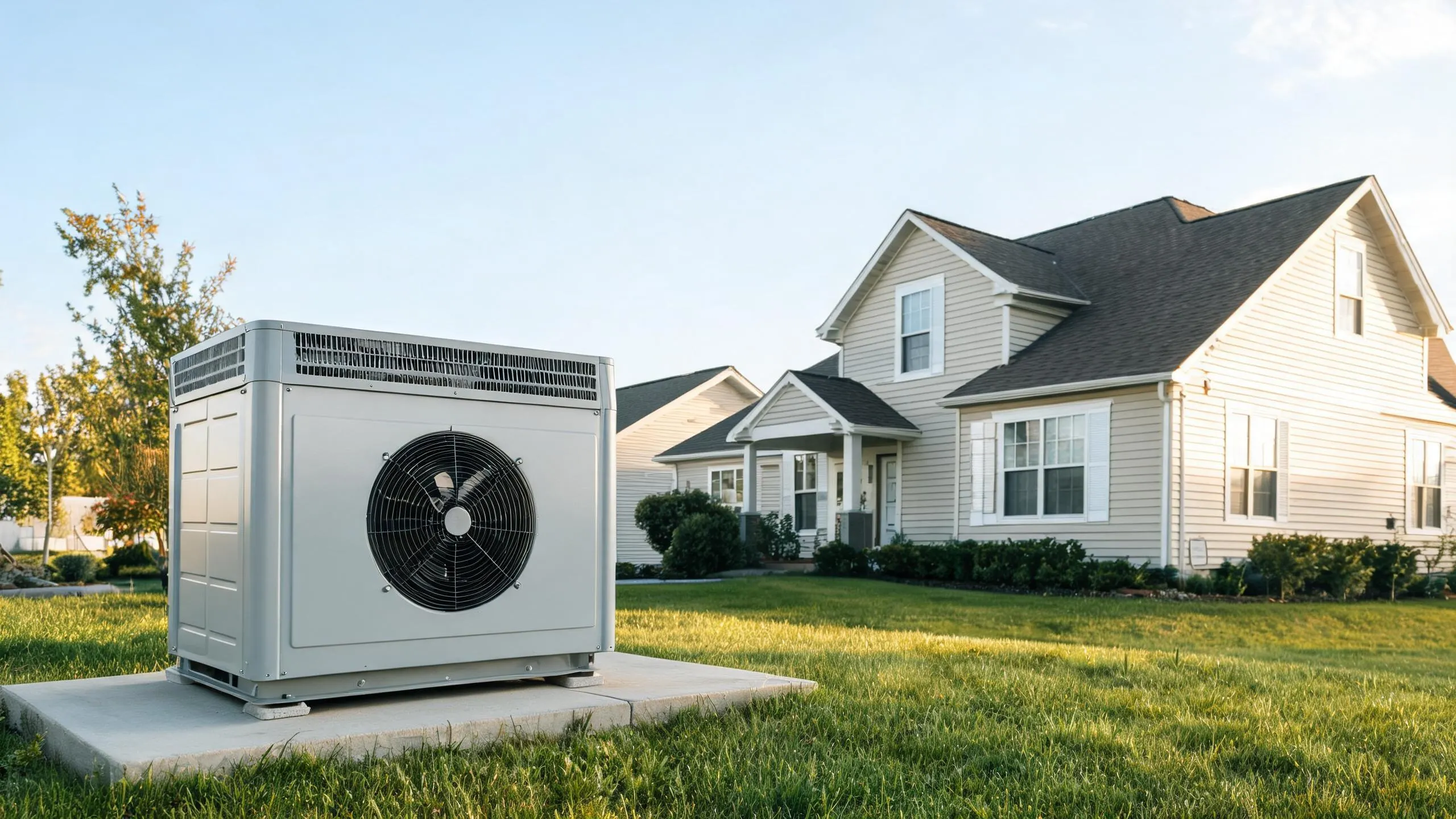





An outdoor heat pump unit mounted on a concrete pad in the front yard of a gray suburban house.

Heat Pump Installation in Madill, OK

Tell us about the job

Takes about a minute. No obligation.

New system or replacementHeat PumpMarshall County, OK
Step 1 of 2

What ZIP code is the job in?

Electricity heats 73.5% of homes in Marshall County, more than every other fuel combined. Gas reaches 17.3%, and propane another 5.9%, but electric is what this county runs on. A heat pump fits right into that setup since it runs on electricity already. For a home that's never had gas service, that matters. There's no gas line to run and no new meter to arrange with the utility. The install comes down to the unit itself and the ductwork or wiring already in place.

5 months
November through March, your system heats
5 months
May through September, it cools
34°F
the average winter night it heats against
93°F
the average summer afternoon it cools against
Isometric line illustration of a cutaway single-story house showing interior rooms with ducted air distribution, an indoor air handler, furniture, and an outdoor condenser unit connected by lines outside the wall.
Your system heats November through March and cools May through September.

NOAA nClimDiv, 1991–2020 normals

Marshall County has seen its share of wind and hail, same as the rest of the region.

A heat pump here just needs a standard install, nothing built bigger or stronger for this county.

October gets you through before the heat pump has to work

Cooling runs May through September
Heat runs November through March
Power costs 12.24 cents a kWh statewide

Madill sits in climate zone 3A, warm and humid with a long stretch of cooling and only a short mild winter. Any heat pump installed here new has to meet 14.3 SEER2 for cooling and 7.5 HSPF2 for heating, the federal floor for equipment built from 2023 forward. That number is higher than what a lot of the country requires, since this region runs its AC so much harder than it runs its heat. Straight central air without a heat pump attached falls under that same regional minimum. Whatever goes in, it has to clear that bar first. A federal tax credit is available on qualifying equipment, worth checking against whatever system you're comparing.

A standard heat pump is the right fit here

Half the homes in Marshall County were built in 1985 or earlier, and a third of the county's housing is mobile homes. Neither of those calls for anything special in a heat pump. What goes in is a standard size and efficiency rating, matched to the space it's heating and cooling. The work is sizing it right for your home and running it with whatever ductwork or wiring is already there.

Find a contractor
A gray heat pump outdoor unit mounted on a concrete pad next to the stone-accented exterior wall of a house.

Sized for the space, not the season

Sizing a heat pump isn't about picking the biggest unit available. Too big, and it cools or heats the space fast, then shuts off before it's pulled the moisture out of the air or warmed things evenly, so it cycles on and off all day instead of running steady. Too small, and it runs constantly without ever quite catching up on the hottest or coldest days. A contractor works this out with a load calculation, looking at the square footage, the windows, the insulation, the orientation of the house, not just a rule of thumb based on the size of the old unit. A heat pump that's sized right runs in long, steady stretches most of the year. That steady running is easier on the compressor than constant short cycling, and it's quieter too.

Ask what happens below freezing

Every heat pump loses some capacity as the outdoor temperature drops, and most have a backup heat source that kicks in when the unit alone can't keep up. Ask what that backup is, how it's controlled, and at what outdoor temperature it switches on. A system that leans on backup heat too early costs more to run than one sized and controlled well.
Ask about the ductwork, not just the unit

A heat pump moves a different volume of air than a straight AC system, and older ducts built for a gas furnace don't always match what the new system wants to push through them. Ask whoever is quoting the job whether they looked at the duct sizing and the return air, not just the condenser and air handler. A unit rated well on paper still runs poorly through ductwork that can't keep up with it.

Taking out the old system is part of the job, not an afterthought. If it's a straight AC with a furnace, the furnace usually stays unless you're replacing the whole setup, since the heat pump takes over the heating the furnace used to do. The old condenser gets disconnected and hauled off, and the refrigerant in it has to be recovered properly rather than vented, that's a legal requirement, not a courtesy. Indoors, the coil gets swapped too, since the old one isn't built to match the new system's charge and airflow. Whoever pulls the permit should also handle the disposal and the refrigerant recovery as part of the quote, not as something billed separately after the fact.

Install day starts with the refrigerant lines and the electrical, not the unit itself. The outdoor condenser needs a spot on a level pad with air on all sides, and the indoor coil has to match up with whatever air handler or furnace it's tying into. If the system is switching from gas heat to a heat pump, expect new wiring run for the outdoor unit and possibly a change to the electrical panel, since a heat pump draws power the old gas furnace never did. The line set gets run between indoor and outdoor units, then the whole system gets pressure tested before any refrigerant goes in, checking for leaks at every joint. Once it holds pressure, the system gets charged, and that charge has to match what the manufacturer specifies for the length of line set run, not just a standard fill. Before anyone leaves, the system should run through a full cycle in both heating and cooling so you can see it actually works, not just that it powers on.